Understanding synonyms and antonyms is an important part of building a strong English vocabulary. These two types of word relationships help readers understand unfamiliar words, express ideas more clearly, and choose appropriate vocabulary for different situations. Although both deal with word meanings, they describe different relationships.
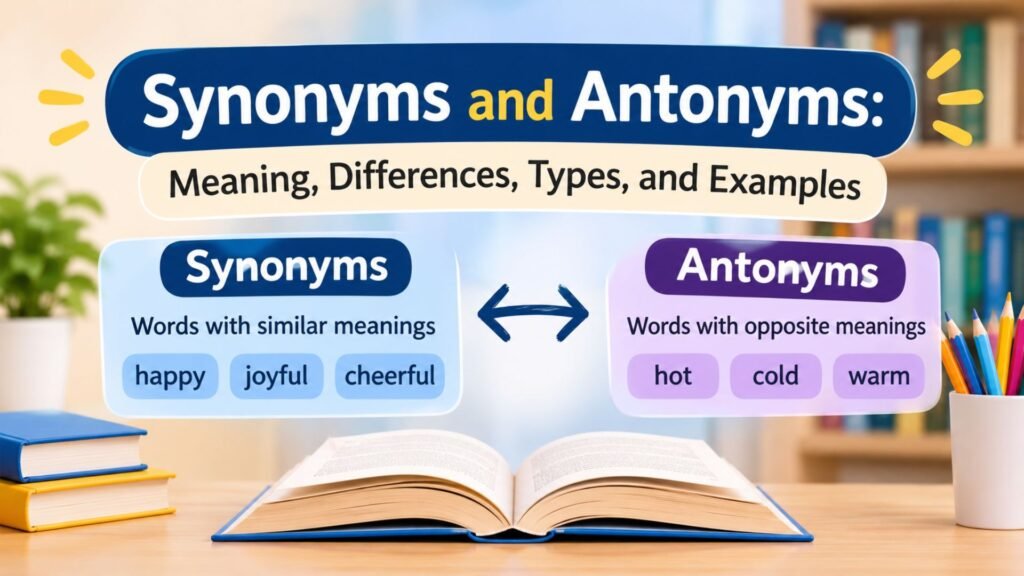
Synonyms are words that have the same or nearly the same meaning, while antonyms are words that have opposite or contrasting meanings. For example, happy and joyful are synonyms, whereas happy and sad are antonyms. Learning these relationships makes it easier to understand sentences, avoid unnecessary repetition, and communicate more effectively.
However, finding a suitable alternative is not always as simple as choosing a word from a list. Some synonyms have slightly different meanings, and certain antonyms express opposite ideas only in particular contexts. Therefore, understanding how these words work is just as important as memorizing examples. This guide explains synonyms and antonyms, their different types, common examples, practical uses, and the mistakes learners should avoid.
What Are Synonyms and Antonyms?
Synonyms and antonyms are two important categories of vocabulary relationships. They help explain how words connect through meaning. While synonyms express similarity, antonyms communicate contrast or opposition.
What Are Synonyms?
A synonym is a word that has the same or nearly the same meaning as another word. Synonyms allow people to express similar ideas using different vocabulary.
For example:
- Happy – Joyful
- Big – Large
- Begin – Start
- Beautiful – Attractive
- Quick – Fast
- Intelligent – Smart
- Difficult – Hard
- Quiet – Silent
Consider this sentence:
The students were happy about their results.
You could replace happy with pleased:
The students were pleased about their results.
Both sentences communicate a similar idea. However, pleased may suggest satisfaction with a particular outcome, while happy can describe a broader emotional state.
Synonyms are especially useful in writing because they help avoid repetition and make descriptions more precise. Nevertheless, similar words are not always interchangeable.
What Are Antonyms?
An antonym is a word that expresses the opposite or contrasting meaning of another word. Antonyms help readers understand differences between ideas, qualities, actions, and conditions.
For example:
- Hot – Cold
- Happy – Sad
- Big – Small
- Early – Late
- Strong – Weak
- Accept – Reject
- Success – Failure
- Arrive – Depart
Consider this sentence:
The weather was extremely hot yesterday.
Replacing hot with its antonym creates a contrasting meaning:
The weather was extremely cold yesterday.
Antonyms are useful when comparing two situations, describing differences, and emphasizing contrasting ideas. In addition, writers use them to create balance and make explanations easier to understand.
Synonyms and Antonyms: Key Differences
Although both concepts describe relationships between words, their purposes are different.
Feature
Synonyms
Antonyms
Meaning
Same or similar meaning
Opposite or contrasting meaning
Main purpose
Express similar ideas
Show differences
Vocabulary use
Provides alternatives
Creates contrast
Example
Happy – Joyful
Happy – Sad
Writing benefit
Reduces repetition
Highlights opposing ideas
Reading benefit
Helps explain unfamiliar words
Helps understand contrasting meanings
The easiest way to remember the difference is that synonyms bring similar meanings together, whereas antonyms connect words with contrasting meanings.
For example, intelligent and clever describe similar qualities. In contrast, intelligent and unintelligent communicate opposing qualities.
Common Examples of Synonyms and Antonyms
Learning examples is one of the easiest ways to understand how similar and opposite words work. The following lists include commonly used English vocabulary.
30 Common Synonyms
Word
Synonym
Happy
Joyful
Sad
Unhappy
Big
Large
Small
Tiny
Beautiful
Attractive
Smart
Intelligent
Quick
Fast
Slow
Sluggish
Begin
Start
End
Finish
Easy
Simple
Difficult
Challenging
Angry
Furious
Calm
Peaceful
Brave
Courageous
Afraid
Scared
Rich
Wealthy
Poor
Impoverished
Help
Assist
Ask
Inquire
Answer
Reply
Choose
Select
Important
Significant
Honest
Truthful
Quiet
Silent
Funny
Humorous
Tired
Exhausted
Correct
Accurate
Idea
Thought
Gift
Present
These examples demonstrate how different words can communicate similar ideas. However, context still matters. For instance, exhausted generally expresses a stronger level of tiredness than tired.
30 Common Antonyms
Word
Antonym
Happy
Sad
Hot
Cold
Big
Small
Tall
Short
Fast
Slow
Strong
Weak
Light
Heavy
Early
Late
Rich
Poor
Easy
Difficult
Beautiful
Ugly
Brave
Cowardly
Honest
Dishonest
Open
Closed
Begin
End
Success
Failure
Victory
Defeat
Accept
Reject
Arrive
Depart
Increase
Decrease
Give
Take
Love
Hate
Friend
Enemy
Clean
Dirty
Loud
Quiet
Ancient
Modern
Expand
Shrink
Remember
Forget
Include
Exclude
Create
Destroy
Some pairs represent direct opposites, while others express contrasting positions or actions. For example, increase and decrease describe opposite directions of change.
Types of Synonyms
Not every synonym has exactly the same meaning. In fact, words can share a general meaning while differing in intensity, tone, or usage. Understanding these differences helps you select more appropriate vocabulary.
1. Absolute Synonyms
Absolute synonyms are words that have almost identical meanings and can be substituted for each other in many situations without changing the intended message.
Examples include:
- Sofa – Couch
- Begin – Commence (in certain contexts)
- Purchase – Buy (in many contexts)
However, completely interchangeable synonyms are uncommon. Even familiar pairs can differ in formality, regional preference, or grammatical usage.
2. Partial Synonyms
Partial synonyms have similar meanings but are not interchangeable in every situation.
For example:
- Angry – Annoyed
- Big – Enormous
- Look – Stare
- Tired – Exhausted
- Beautiful – Gorgeous
Consider angry and annoyed. Both describe negative emotional reactions, but angry generally communicates a stronger emotion than annoyed.
Similarly, look and stare both involve directing your eyes toward something. However, stare suggests looking for an extended period, often with a fixed gaze.
3. Contextual Synonyms
Contextual synonyms are words that have similar meanings in a particular situation but may have different meanings elsewhere.
For example, bright can describe light, intelligence, or color.
- Bright light – Strong light
- Bright student – Intelligent student
- Bright color – Vivid color
Therefore, an appropriate synonym depends on the meaning of the original word in its sentence.
Types of Antonyms
Antonyms do not all express opposition in the same way. Linguists commonly distinguish between several types based on the relationship between the meanings.
1. Gradable Antonyms
Gradable antonyms describe opposite ends of a scale. They allow intermediate degrees between the two extremes.
Examples:
- Hot – Cold
- Big – Small
- Rich – Poor
- Happy – Sad
- Fast – Slow
- Easy – Difficult
For instance, something does not have to be either hot or cold. It could also be warm, cool, or mildly cold.
Similarly, a person can be neither completely happy nor completely sad. Gradable opposites allow different levels of the same quality.
2. Complementary Antonyms
Complementary antonyms describe opposing conditions where one generally excludes the other within the same context.
Examples:
- Alive – Dead
- Present – Absent
- True – False
- On – Off
- Legal – Illegal
For instance, a person attending a particular meeting is either present or absent at a given time. There is no ordinary middle position between these two conditions.
However, the precise interpretation can depend on the situation. Some words that appear absolute may have special uses in particular contexts.
3. Relational Antonyms
Relational antonyms describe two opposite roles or perspectives that depend on each other.
Examples:
- Buy – Sell
- Give – Receive
- Teacher – Student
- Parent – Child
- Employer – Employee
- Borrow – Lend
For example, when someone buys a book from a shop, the shop sells that same book. Both words describe the same transaction from different perspectives.
Likewise, borrowing and lending describe opposite sides of the same exchange.
How to Use Synonyms and Antonyms in Sentences
Understanding definitions is useful, but applying vocabulary correctly is even more important. Synonyms and antonyms can improve sentences in different ways.
Using Synonyms to Improve Writing
Synonyms help writers express ideas without repeating the same words unnecessarily.
Consider this example:
The beautiful garden had beautiful flowers and a beautiful fountain.
The repeated adjective makes the description less interesting.
A better version would be:
The lovely garden featured colorful flowers and an attractive fountain.
Here, alternative vocabulary creates a more varied description.
Other examples include:
Original Sentence
Improved Sentence
She is a smart student.
She is an intelligent student.
The task was difficult.
The task was challenging.
He gave a quick response.
He gave a rapid response.
We need to begin the project.
We need to start the project.
The room was quiet.
The room was peaceful.
Remember that the replacement must preserve the intended meaning and fit naturally into the sentence.
Using Antonyms to Show Contrast
Antonyms help communicate differences between people, situations, and ideas.
For example:
- The first road was wide, but the second was narrow.
- Her answer was correct, whereas mine was incorrect.
- The morning was bright, but the evening became dark.
- The old building looked small beside the new, enormous structure.
- Some students arrived early, while others arrived late.
These sentences use contrasting vocabulary to make differences clear.
Furthermore, antonyms can strengthen comparisons in essays, reports, stories, and everyday conversations.
Synonyms and Antonyms in Different Contexts
Choosing the right word depends on your audience, purpose, and writing style. A synonym that works in casual conversation may not be the best choice in academic or professional writing.
Formal and Academic Writing
Formal writing often requires precise and professional vocabulary. Some common alternatives include:
Common Word
Formal Alternative
Help
Assist
Show
Demonstrate
Get
Obtain
Need
Require
Start
Commence
End
Conclude
Ask
Inquire
Use
Utilize
Tell
Inform
Important
Significant
For example:
Casual: The teacher helped the students understand the topic.
Formal: The teacher assisted the students in understanding the topic.
Although these alternatives sound more formal, they should not replace simpler words automatically. A clear and natural sentence is usually better than one filled with unnecessarily complicated vocabulary.
Everyday Conversations
Informal vocabulary makes conversations sound natural and comfortable.
Examples include:
- Happy – Glad
- Friend – Buddy
- Excellent – Great
- Food – Grub (informal)
- Angry – Mad
- Tired – Sleepy
- Child – Kid
- Home – House (not interchangeable in every context)
For example:
I’m glad you could join us.
The word glad is a natural alternative to happy in this situation.
Creative Writing
Writers use synonyms and antonyms to make descriptions more expressive.
For example, instead of writing:
The room was dark and the atmosphere was sad.
You could write:
The dim room created a gloomy atmosphere.
Similarly, contrasting words can make a character or setting more interesting:
Although the town looked peaceful during the day, it became noisy after sunset.
In this way, vocabulary choices help communicate atmosphere, emotion, and contrast.
How to Find the Right Synonym or Antonym
A dictionary or thesaurus can provide several alternatives for a word. Nevertheless, choosing the correct one requires more than looking at a list.
Follow these practical steps:
- Identify the meaning: Determine what the original word means in the sentence.
- Understand the context: Consider the subject, situation, and intended message.
- Check the part of speech: Make sure the alternative has the correct grammatical function.
- Compare word intensity: Decide whether you need a stronger, weaker, or equally strong expression.
- Consider the tone: Choose vocabulary that matches formal, informal, or academic writing.
- Check the sentence: Replace the original word and read the sentence again.
- Verify the meaning: Consult a reliable dictionary if you are uncertain.
For example, suppose you want a synonym for beautiful. Possible alternatives include attractive, gorgeous, lovely, and elegant.
However, each has a slightly different emphasis:
- Attractive describes something that appeals to the senses or interests someone.
- Gorgeous expresses a particularly strong sense of beauty.
- Lovely often communicates pleasantness or charm.
- Elegant emphasizes grace, refinement, or tasteful appearance.
Therefore, the best choice depends on what you want to describe.
Common Mistakes When Using Synonyms and Antonyms
Even experienced English learners sometimes confuse similar and opposite words. Avoiding the following mistakes can improve vocabulary accuracy.
1. Assuming All Synonyms Are Interchangeable
Words with similar meanings may have different levels of intensity or specific uses.
For example, thin and slim both describe a small body width, but slim often carries a more positive or neutral connotation.
Using one automatically in place of the other may change the tone.
2. Choosing a Synonym Without Checking Context
A word can have several meanings, and its synonyms may change accordingly.
For instance, bright can mean:
- Full of light
- Intelligent
- Vivid in color
The alternatives shining, clever, and vivid apply to different meanings. Therefore, context should guide your selection.
3. Confusing Related Words With Antonyms
Not every pair of different words represents an opposite relationship.
For example, cat and dog are different animals, but they are not antonyms. Similarly, summer and winter are contrasting seasons, but their relationship is not the same as hot and cold.
An antonym must express an actual opposing meaning, not simply a different concept.
4. Ignoring Grammar
A synonym must fit the grammatical structure of the original sentence.
For example:
- Decide (verb) – Choose (verb)
- Decision (noun) – Choice (noun)
- Decisive (adjective) – Determined (adjective, in some contexts)
Replacing a noun with a verb without changing the sentence structure can create a grammatical error.
5. Using Complicated Words Unnecessarily
A longer or less familiar word is not automatically better.
For example, help is often clearer than facilitate in everyday communication. Similarly, use is frequently more natural than utilize.
Choose words for accuracy and clarity rather than complexity.
Synonyms and Antonyms vs. Other Word Relationships
English contains several types of relationships between words. Understanding their differences can prevent confusion.
Word Relationship
Definition
Example
Synonyms
Words with similar meanings
Begin – Start
Antonyms
Words with opposite meanings
Begin – End
Homonyms
Words with the same spelling or pronunciation but different meanings
Bat (animal) – Bat (sports equipment)
Homophones
Words with the same pronunciation but different meanings and often different spellings
Sea – See
Homographs
Words with the same spelling but different meanings, sometimes different pronunciations
Tear (rip) – Tear (from the eye)
These relationships are useful in different ways.
For example, synonyms and antonyms focus on meaning, whereas homophones focus on pronunciation. Homographs, on the other hand, share spelling but can have different meanings and pronunciations.
Recognizing these distinctions makes vocabulary learning more systematic.
Why Are Synonyms and Antonyms Important?
Learning similar and opposite words offers several practical benefits for English communication.
1. Builds a stronger vocabulary: Learning alternative words introduces new meanings, expressions, and ways to communicate ideas.
2. Improves writing quality: Synonyms reduce unnecessary repetition and help writers choose more precise vocabulary.
3. Supports reading comprehension: Recognizing similar and opposite meanings makes unfamiliar sentences easier to understand.
4. Develops critical thinking: Comparing word meanings encourages learners to notice subtle differences between concepts.
5. Improves communication: A wider vocabulary helps people explain their thoughts more clearly in conversations, presentations, and written work.
6. Supports language learning: Students can use word relationships to remember vocabulary and understand how English words connect.
Ultimately, these skills are useful for students, teachers, writers, and anyone interested in developing stronger English language abilities.
FAQs
1. What are synonyms and antonyms in simple words?
Synonyms are words that have the same or similar meanings, while antonyms are words with opposite or contrasting meanings. For example, happy and joyful are synonyms, whereas happy and sad are antonyms.
2. What are 10 examples of synonyms?
Here are 10 common synonym pairs:
- Happy – Joyful
- Big – Large
- Small – Tiny
- Fast – Quick
- Smart – Intelligent
- Begin – Start
- Easy – Simple
- Beautiful – Attractive
- Brave – Courageous
- Difficult – Challenging
3. What are 10 examples of antonyms?
Here are 10 commonly used antonym pairs:
- Hot – Cold
- Happy – Sad
- Big – Small
- Strong – Weak
- Early – Late
- Light – Heavy
- Open – Closed
- Success – Failure
- Accept – Reject
- Increase – Decrease
4. Can a word have more than one synonym or antonym?
Yes. A word can have several synonyms and antonyms depending on its meaning and context.
For example, happy has synonyms such as joyful, pleased, and cheerful. Its common antonyms include sad, unhappy, and miserable.
5. Are synonyms and antonyms always exact opposites or matches?
No. Most synonyms share only part of their meaning, while antonyms can express different kinds of opposition.
For example, hot and cold are gradable opposites because temperatures can fall between them. Likewise, big and enormous are similar, but enormous communicates a greater degree of size.
6. How do synonyms and antonyms improve vocabulary?
Synonyms introduce alternative ways to express an idea, while antonyms help learners understand contrasting meanings. Together, they improve word recognition, reading comprehension, writing variety, and communication skills.
7. What is the best way to learn synonyms and antonyms?
Start with common words and learn their alternatives through sentences rather than memorizing isolated lists. Additionally, use a reliable dictionary or thesaurus to check meanings, grammatical forms, and contextual differences. Practicing a few word pairs regularly can make vocabulary learning more effective.
8. Do all English words have antonyms?
No. Some words have clear opposites, but others do not have a natural antonym.
For example, hot has the opposite cold, while table does not have a standard antonym. Antonyms are meaningful relationships between certain words, not a requirement for every word in English.
Conclusion
Synonyms and antonyms are essential tools for understanding English vocabulary and communicating ideas effectively. Synonyms help express similar meanings through alternative words, while antonyms make contrasting ideas easier to recognize and explain.
However, learning these relationships involves more than memorizing word pairs. Understanding context, grammatical function, tone, and subtle differences allows you to choose vocabulary accurately. Whether you are writing an essay, reading a challenging passage, or having an everyday conversation, using appropriate synonyms and antonyms can make your language clearer, more varied, and more effective.

Ethan Whitmore is a language and vocabulary writer focused on synonyms, antonyms, word meanings, and better word choices. He enjoys making language simple, clear, and useful for everyday writing.