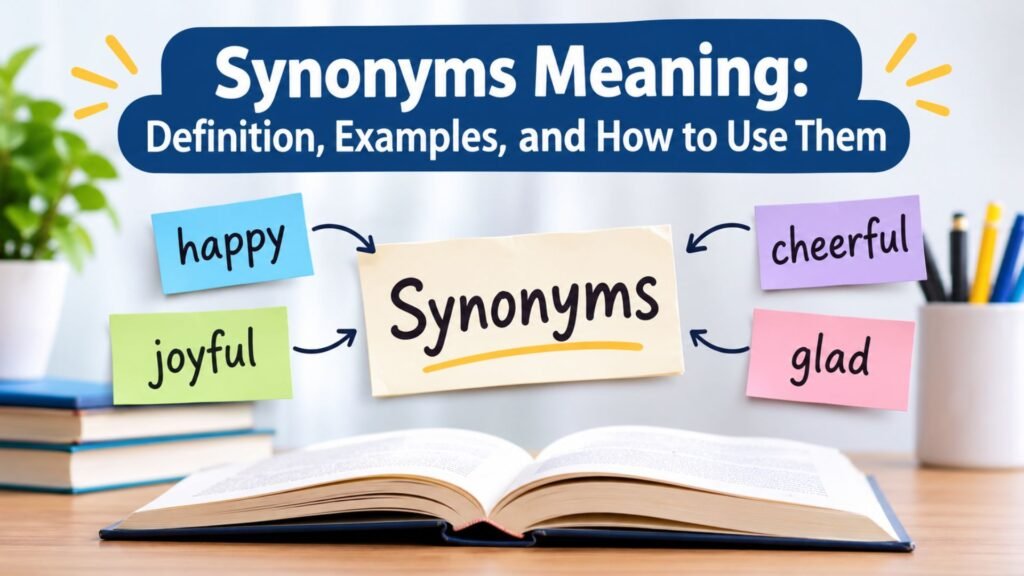
Understanding the synonyms meaning can help you expand your English vocabulary, improve your writing, and express ideas more clearly. A synonym is a word or phrase that has the same or nearly the same meaning as another word. For example, happy and joyful, big and large, and quick and fast are common pairs of synonyms.
However, synonyms are not always interchangeable. Although two words may share a similar meaning, they can differ in tone, strength, formality, or the situations in which people use them. For instance, angry and furious both describe an unpleasant emotion, but furious expresses a much stronger feeling.
Learning what synonyms mean involves more than memorizing alternative words. It also means understanding their meanings, recognizing small differences, and choosing the right expression for each situation. In this guide, you will learn the definition of synonyms, practical examples, different types, common uses, and the differences between synonyms and related vocabulary terms.
What Does Synonyms Mean?
The word synonyms refers to two or more words or expressions that have the same or nearly the same meaning. These words are used to communicate similar ideas, describe comparable situations, or express the same general feeling.
For example:
- Happy — Joyful
- Big — Large
- Small — Little
- Beautiful — Attractive
- Begin — Start
- Fast — Quick
- Smart — Intelligent
- Easy — Simple
- Angry — Mad
- Help — Assist
In each pair, both words communicate a similar idea. Nevertheless, their meanings may have slightly different shades depending on the context.
Consider the words begin and commence. Both mean to start something. However, begin is suitable for everyday conversation, whereas commence generally sounds more formal.
Therefore, understanding synonyms means recognizing both the shared meaning and the differences that influence correct word choice.
Simple Definition of Synonyms
A simple definition of synonyms is:
Synonyms are words that have the same or similar meanings and can sometimes replace one another in a sentence without significantly changing its meaning.
For example:
- Original: She is a happy person.
- With a synonym: She is a cheerful person.
Both sentences describe someone who experiences or expresses happiness.
However, replacing a word requires attention to grammar and context. Not every similar word will fit naturally into every sentence.
What Is an Example of a Synonym?
One of the easiest ways to understand synonyms is through familiar words and their alternatives.
Here are 20 common examples:
WordSynonymMeaningHappyJoyfulFeeling pleasureSadUnhappyFeeling sorrowBigLargeGreater in sizeSmallTinyVery little in sizeFastQuickMoving at high speedSmartIntelligentHaving good mental abilityBeautifulAttractivePleasing to look atEasySimpleNot difficultDifficultChallengingRequiring effortBeginStartTo do something firstEndFinishTo bring something to a closeAngryFuriousFeeling strong angerBraveCourageousShowing courageAfraidScaredFeeling fearRichWealthyHaving considerable moneyPoorNeedyLacking financial resourcesHelpAssistTo provide supportQuietSilentMaking little or no noiseHonestTruthfulSpeaking or showing the truthChooseSelectTo pick an option
These examples show how different words can communicate similar ideas. However, some alternatives express a stronger or more specific meaning.
For example, tiny usually suggests a very small size, while small is a more general description. Similarly, furious expresses stronger anger than angry.
Types of Synonyms in English
Synonyms can have different relationships depending on how closely their meanings match. Understanding these categories helps learners choose more accurate vocabulary.
1. Absolute Synonyms
Absolute synonyms are words that have exactly the same meaning and can replace one another in the same contexts without changing the intended message.
However, completely interchangeable synonyms are uncommon in everyday English. Even words that appear identical may have differences in usage, regional preference, or grammatical patterns.
For example, sofa and couch generally refer to the same type of furniture. In ordinary conversation, either word can describe the same object.
Absolute synonymy is therefore a relatively limited relationship rather than something that applies to most synonym pairs.
2. Partial Synonyms
Partial synonyms are words that share some meanings but are not interchangeable in every situation.
For example:
- Big — Large
- Angry — Furious
- Thin — Slim
- Smart — Clever
- Difficult — Hard
These words overlap in meaning, but each has its own emphasis.
Consider thin and slim. Both describe someone or something with a relatively small width. However, slim can suggest an elegant or narrow shape, while thin is more neutral and has several other uses.
Partial synonyms are particularly important because they make vocabulary more precise.
3. Contextual Synonyms
Contextual synonyms are words that have similar meanings only in particular situations.
For example, bright and intelligent can describe someone with strong mental abilities.
- She is a bright student.
- She is an intelligent student.
In this context, the words communicate a similar idea.
However, bright can also describe strong light or vivid colors. In those situations, intelligent cannot replace it.
Consequently, contextual synonyms require an understanding of the sentence rather than a simple word-for-word replacement.
Synonyms by Different Word Categories
English synonyms appear across different parts of speech, including nouns, verbs, adjectives, and adverbs.
Understanding these categories makes it easier to recognize and use alternative vocabulary correctly.
1. Noun Synonyms
Nouns identify people, places, objects, feelings, and ideas. Their synonyms provide alternative ways to refer to similar things.
NounSynonymFriendCompanionJobOccupationIdeaThoughtGiftPresentMistakeErrorFreedomLibertyGoalObjectiveAnswerResponseStoryTaleProblemIssue
Example:
- Original: She gave me a wonderful gift.
- Alternative: She gave me a wonderful present.
Both sentences communicate the same general idea.
2. Verb Synonyms
Verbs describe actions, events, and states. Using appropriate alternatives can make sentences more varied and expressive.
VerbSynonymBeginStartFinishCompleteHelpAssistSpeakTalkBuyPurchaseMakeCreateShowDisplayAskInquireImproveEnhanceChooseSelect
Example:
- Original: The teacher will help the students.
- Alternative: The teacher will assist the students.
Both sentences describe providing support, although assist sounds slightly more formal.
3. Adjective Synonyms
Adjectives describe the qualities, characteristics, or conditions of nouns.
AdjectiveSynonymHappyCheerfulBeautifulLovelyBraveCourageousCleverIntelligentCalmPeacefulDifficultChallengingHonestTruthfulAngryAnnoyedKindCaringImportantSignificant
Example:
- Original: This is an important decision.
- Alternative: This is a significant decision.
The second sentence uses a slightly more formal alternative.
4. Adverb Synonyms
Adverbs describe how, when, where, or to what extent an action happens.
AdverbSynonymQuicklyRapidlySlowlyGraduallyCarefullyCautiouslyClearlyObviouslyHappilyCheerfullyEasilyEffortlesslyQuietlySilentlyCorrectlyAccuratelyOftenFrequentlySuddenlyAbruptly
Example:
- Original: She completed the assignment quickly.
- Alternative: She completed the assignment rapidly.
Both alternatives describe a fast action, although their naturalness can depend on the context.
Why Are Synonyms Important?
Synonyms are useful in everyday communication, education, professional writing, and vocabulary development. They allow people to express ideas in different ways while maintaining the intended meaning.
Here are some important benefits.
1. They Improve Vocabulary
Learning alternative words introduces you to different expressions and helps you understand English more deeply.
For example, instead of knowing only the word happy, you can learn cheerful, delighted, joyful, and pleased.
As your vocabulary grows, you become more comfortable understanding and using different expressions.
2. They Make Writing More Interesting
Repeating the same word several times can make a paragraph sound monotonous.
Synonyms provide alternatives that help maintain a natural flow.
For example:
Repetitive version:
The project was difficult. The difficult project required difficult decisions.
Improved version:
The project was challenging and required several complicated decisions.
The revised version communicates the same general idea with greater variety.
3. They Help Express Ideas More Precisely
Although similar words share meanings, some communicate particular feelings or levels of intensity more effectively.
For example:
- Happy describes a general positive emotion.
- Pleased expresses satisfaction.
- Delighted communicates strong happiness.
- Thrilled suggests intense excitement.
Choosing the right alternative helps readers understand exactly what you mean.
4. They Support Reading Comprehension
Writers use different vocabulary to communicate similar ideas. Therefore, recognizing synonyms can help readers understand unfamiliar words through context.
For instance, if a passage describes someone as courageous and later calls that person brave, understanding the relationship between the two words makes the passage easier to follow.
5. They Improve Speaking Skills
Knowing alternative expressions makes everyday conversations more flexible.
Instead of always saying good, you might use excellent, pleasant, wonderful, or satisfactory, depending on the situation.
As a result, you can communicate more naturally and choose expressions that better match your thoughts.
Difference Between Synonyms and Antonyms
Synonyms and antonyms are two important vocabulary concepts. However, they describe opposite types of relationships between words.
A synonym has the same or a similar meaning as another word. In contrast, an antonym expresses an opposite meaning.
FeatureSynonymsAntonymsMeaningSame or similar meaningOpposite meaningPurposeProvide alternative expressionsShow contrastExample 1Happy — JoyfulHappy — SadExample 2Big — LargeBig — SmallExample 3Begin — StartBegin — EndExample 4Easy — SimpleEasy — DifficultExample 5Brave — CourageousBrave — Cowardly
Examples of Synonyms
- Beautiful — Attractive
- Quick — Fast
- Intelligent — Smart
- Quiet — Silent
- Difficult — Challenging
Examples of Antonyms
- Hot — Cold
- Light — Dark
- Success — Failure
- Love — Hate
- Strong — Weak
Simply put, synonyms help express similar ideas, whereas antonyms help communicate differences.
How to Use Synonyms Correctly in Sentences
Finding an alternative word is only the first step. You must also understand how to use it naturally in a sentence.
Follow these practical guidelines.
1. Understand the Original Meaning
Before replacing a word, identify what it means in the sentence.
For example, bright can describe light, color, or intelligence.
- The room is bright.
- She is a bright student.
Although the same word appears in both sentences, its meaning changes according to context. Therefore, the correct alternative will also change.
2. Check the Part of Speech
Always choose an alternative that fits the grammatical structure.
For example:
- Beautiful is an adjective.
- Beauty is a noun.
- Beautifully is an adverb.
These words are related, but they cannot replace one another in every sentence.
Correct: She sings beautifully.
Incorrect: She sings beautiful.
3. Consider the Tone
Some synonyms sound formal, while others are more suitable for casual conversations.
For example:
Everyday WordMore Formal AlternativeAskInquireHelpAssistBuyPurchaseStartCommenceEndConcludeTellInform
In a friendly conversation, ask usually sounds more natural than inquire. However, the formal alternative may work better in a professional letter.
4. Consider the Strength of the Word
Not every synonym communicates the same level of intensity.
For example:
- Annoyed — Slightly irritated
- Angry — Feeling strong displeasure
- Furious — Extremely angry
These words describe related emotions, but their intensity differs.
Consequently, choose the alternative that accurately represents the situation.
5. Read the Complete Sentence Again
After replacing a word, read the entire sentence to check whether it sounds natural.
For example:
Original: The manager made a difficult decision.
Alternative: The manager made a challenging decision.
Both sentences are grammatically correct, but difficult decision may be the more natural expression in this particular context.
Common Mistakes When Using Synonyms
Even experienced English learners sometimes choose alternatives that do not fit their intended meaning.
Understanding these mistakes can help you develop better vocabulary habits.
1. Assuming All Synonyms Are Interchangeable
Two words can have similar meanings without being suitable replacements in every sentence.
For example, slim and thin overlap in meaning, but they can create different impressions.
Always consider the context before choosing an alternative.
2. Choosing Complicated Words Unnecessarily
Some writers believe that longer or more formal words automatically improve their writing.
However, complicated vocabulary does not always make a sentence better.
For example, use is often clearer and more natural than utilize.
Choose clarity instead of complexity.
3. Ignoring Grammar
A synonym must fit the grammatical role of the original word.
For instance, replacing an adjective with a noun can make a sentence incorrect.
Check the part of speech before making a substitution.
4. Ignoring Tone and Formality
Words that communicate similar ideas may belong to different communication styles.
For example, kids is informal, while children is more neutral and suitable for many formal contexts.
Selecting the wrong tone can make otherwise correct writing sound awkward.
5. Relying Only on Thesaurus Lists
A thesaurus can provide useful alternatives, but its suggestions are not always suitable for your sentence.
Some entries include words that share only one particular meaning.
Therefore, consult a dictionary when you are unsure about a word’s definition, grammatical use, or connotation.
How to Find the Right Synonym
Finding an appropriate alternative becomes easier when you follow a consistent process.
- Identify the original word: Determine what you want to replace.
- Understand its meaning: Consider how the word functions in the sentence.
- Explore alternatives: Use a reliable dictionary or thesaurus to find related words.
- Compare definitions: Check whether the alternatives communicate the intended idea.
- Check grammar: Make sure the replacement has the correct part of speech and fits the sentence.
- Consider the tone: Decide whether you need an everyday, academic, or professional expression.
- Test the sentence: Read the revised version to ensure that it sounds natural.
For example, suppose you want to replace important in an academic essay.
Possible alternatives include:
- Significant
- Essential
- Crucial
- Vital
- Fundamental
However, these words do not have identical meanings. Essential suggests something necessary, while significant emphasizes importance or meaningful impact.
Choosing between them depends on the point you want to communicate.
Frequently Asked Questions About Synonyms Meaning
1. What does synonyms mean in simple words?
Synonyms are two or more words that have the same or similar meanings. For example, happy and joyful are synonyms because both describe a positive emotional state.
2. What is the meaning of synonym with an example?
A synonym is a word that shares the same or nearly the same meaning as another word. For example, big and large are synonyms because both describe something of considerable size.
3. What is the difference between synonym and antonym?
A synonym is a word with a similar meaning, whereas an antonym has an opposite meaning. For example, fast and quick are synonyms, while fast and slow are antonyms.
4. Can two synonyms have slightly different meanings?
Yes. Many synonyms have overlapping meanings but differ in intensity, tone, or usage. For example, angry and furious describe similar emotions, but furious expresses a stronger level of anger.
5. What are the 10 common examples of synonyms?
Here are ten familiar synonym pairs:
- Happy — Joyful
- Big — Large
- Small — Little
- Fast — Quick
- Smart — Intelligent
- Beautiful — Attractive
- Easy — Simple
- Begin — Start
- Help — Assist
- Brave — Courageous
6. Are synonyms always interchangeable?
No. Some synonyms work in the same sentence, while others are appropriate only in specific contexts. Grammar, tone, meaning, and word intensity can affect whether a replacement sounds natural.
7. What is another name for synonyms?
There is no single perfect alternative for the linguistic term synonyms. However, expressions such as similar words, words with related meanings, and alternative expressions can explain the concept in everyday English.
8. How do synonyms improve English vocabulary?
Synonyms introduce learners to alternative expressions and help them understand differences in meaning, tone, and usage. They also support better reading comprehension, more varied writing, and clearer communication.
Conclusion
Understanding the synonyms meaning is an important part of developing a stronger English vocabulary. Synonyms are words or expressions that share the same or nearly the same meanings, allowing people to communicate similar ideas in different ways.
However, choosing the right alternative requires more than finding a word with a similar definition. You should also consider its grammatical role, tone, context, and level of intensity. By learning these differences and practicing with original examples, you can make your writing clearer, improve your communication skills, and use English vocabulary with greater confidence.

Ethan Whitmore is a language and vocabulary writer focused on synonyms, antonyms, word meanings, and better word choices. He enjoys making language simple, clear, and useful for everyday writing.