
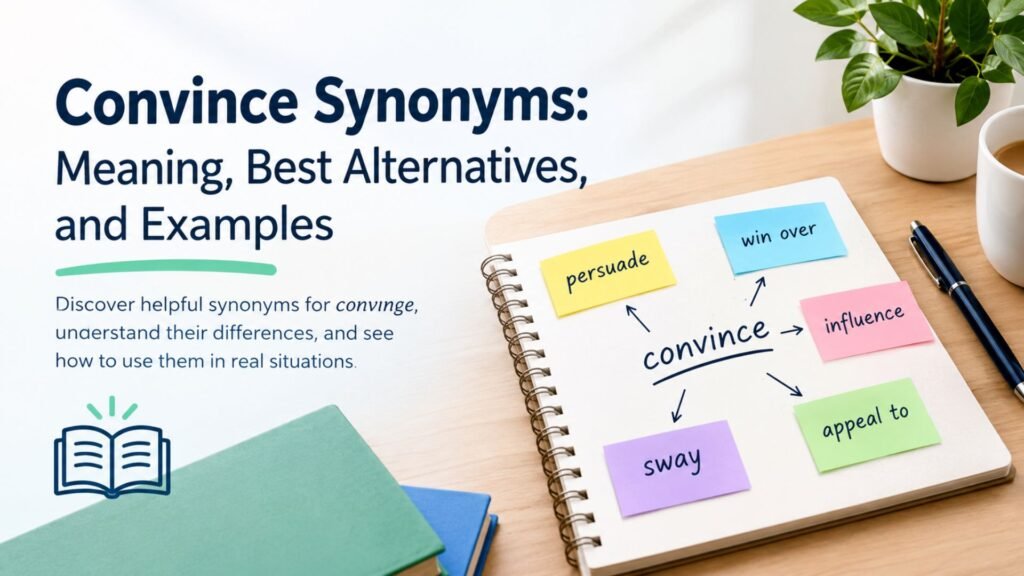
The best synonym for convince depends on what you want to communicate. If you want someone to accept an idea, persuade may be the closest alternative. If you want to help someone understand why a claim is true, assure, reassure, or demonstrate may work better in certain contexts. Choosing the right word makes your writing clearer and helps you express your meaning more precisely.
The verb convince generally means to make someone believe that something is true or to change their opinion through reasons, evidence, or explanation. For example, you might convince a friend that a plan is worthwhile, convince a customer that a product meets their needs, or convince a reader that your argument is supported by evidence. Although these situations share a common idea, each may require a slightly different word.
In this guide, you will discover useful convince synonyms, their meanings, and natural example sentences. You will also learn the differences between convincing and persuading someone, explore formal and informal alternatives, and identify common usage mistakes. As a result, you can choose vocabulary that fits everyday conversations, academic writing, professional communication, and persuasive arguments.
What Does Convince Mean?
Convince is a verb that means to cause someone to believe something is true, accept an argument, or become willing to consider a particular idea. It often involves providing reasons, facts, explanations, or evidence.
For example, a student might convince a teacher that an assignment was submitted on time by showing the submission receipt. Similarly, a business owner might convince a client that a proposed service offers good value by explaining its benefits.
The word can describe two closely related situations:
- Changing someone’s belief: The evidence convinced Maya that the report was accurate.
- Influencing someone’s decision: We convinced the committee to reconsider its decision.
Although both uses are common, the first focuses on belief, while the second focuses on action.
English meaning – Cambridge Dictionary
+1
Best Synonyms for Convince
The following alternatives cover the most useful meanings of convince. Some focus on changing beliefs, while others emphasize influencing decisions, providing reassurance, or demonstrating that something is true.
1. Persuade — To Influence Someone’s Opinion or Decision
Part of speech: Verb
Meaning: To encourage someone to agree with an idea or take a particular action by offering reasons, arguments, or appeals.
Best used when: You want to describe an effort to influence someone’s thinking or behavior.
Example: Liam persuaded his teammates to try a different strategy.
Persuade is usually the closest general alternative to convince. Both words can describe changing someone’s mind, but persuade particularly emphasizes influencing a decision or action. The two words also overlap in everyday English.
Oxford Learner’s Dictionaries
+1
2. Assure — To Give Someone Confidence
Part of speech: Verb
Meaning: To tell someone something confidently so that they feel certain or less doubtful.
Best used when: Someone needs confirmation, confidence, or a clear statement of reassurance.
Example: The manager assured the team that their questions would be addressed.
Unlike convince, which often involves changing a belief through reasoning or evidence, assure emphasizes giving someone confidence. However, an assurance does not automatically prove that a statement is true.
3. Reassure — To Reduce Someone’s Doubts or Worries
Part of speech: Verb
Meaning: To help someone feel less worried by giving them confidence or explaining why their concerns may be unfounded.
Best used when: You want to address uncertainty, anxiety, or a lack of confidence.
Example: The teacher reassured the students that they had enough time to finish the project.
Reassure is more suitable than convince when the main goal is to ease someone’s concerns. For instance, you might reassure a customer about a delivery schedule rather than convince them to purchase something.
4. Sway — To Influence an Opinion or Decision
Part of speech: Verb
Meaning: To influence someone’s judgment, attitude, or choice.
Best used when: A person or factor causes someone to reconsider an opinion or make a different decision.
Example: The new evidence swayed the committee in favor of the proposal.
Sway emphasizes influence rather than complete agreement. Someone can be swayed toward an idea without becoming entirely convinced of its truth.
5. Win Over — To Gain Someone’s Support
Part of speech: Phrasal verb
Meaning: To gain someone’s approval, trust, or support through actions, arguments, or personal qualities.
Best used when: You want to describe building support over time.
Example: The community organizer won over skeptical residents by listening to their concerns.
Unlike convince, win over often suggests a gradual change in attitude. It is particularly natural in conversations about relationships, teamwork, leadership, and public support.
6. Satisfy — To Remove Doubt Through an Adequate Explanation
Part of speech: Verb
Meaning: To provide enough information or evidence to meet someone’s requirements or resolve their doubts.
Best used when: Someone needs convincing proof, a reasonable explanation, or sufficient evidence.
Example: The auditor was satisfied that the financial records were complete.
Satisfy is useful in formal, legal, academic, and professional contexts. However, it does not always mean persuading someone to agree; it can simply mean meeting a standard or resolving a concern.
7. Demonstrate — To Show Something Clearly
Part of speech: Verb
Meaning: To show that something is true or how something works, usually through evidence, examples, or a practical explanation.
Best used when: You want to establish a claim with observable facts or a clear explanation.
Example: The experiment demonstrated that the revised method produced consistent results.
Demonstrate focuses on showing rather than directly influencing a person’s opinion. Therefore, it is especially useful in scientific reports, presentations, and evidence-based arguments.
8. Establish — To Show That Something Is True or Valid
Part of speech: Verb
Meaning: To provide sufficient grounds for accepting a fact, conclusion, or claim.
Best used when: You are presenting findings, building an argument, or supporting a conclusion.
Example: The investigation established that the error occurred during data entry.
While convince focuses on the effect on someone’s belief, establish emphasizes demonstrating or determining the validity of a claim. The word is especially useful in academic, legal, and professional writing.
9. Induce — To Bring About a Response or Action
Part of speech: Verb
Meaning: To cause or encourage someone to do something through influence, incentives, or particular circumstances.
Best used when: You need a formal alternative that emphasizes what causes a person to act.
Example: The offer of flexible hours induced several employees to volunteer for the project.
Induce is more formal than convince and can describe causes other than verbal arguments. It does not necessarily mean that someone has accepted an idea as true.
10. Coax — To Encourage Someone Gently
Part of speech: Verb
Meaning: To encourage someone to do something through patience, gentle requests, or friendly persuasion.
Best used when: Someone is reluctant and needs a gentle approach.
Example: Noor coaxed her younger brother into joining the family game.
Unlike convince, coax emphasizes the manner of persuasion. It often suggests a softer approach rather than a strong argument or a presentation of evidence.
11. Cajole — To Persuade Through Friendly Pressure or Flattery
Part of speech: Verb
Meaning: To persuade someone by using charm, flattery, or persistent encouragement.
Best used when: You want to describe a more personal or persistent form of persuasion.
Example: The event coordinator cajoled a few volunteers into helping with the decorations.
Cajole can suggest that the person being persuaded is reluctant. Depending on the context, it may also imply that the persuader is using excessive charm or pressure.
12. Influence — To Affect Someone’s Thinking or Behavior
Part of speech: Verb
Meaning: To affect how someone thinks, feels, decides, or behaves.
Best used when: You want a broad term that does not necessarily imply direct argument or complete agreement.
Example: Positive feedback influenced the team to continue developing the idea.
Influence is broader than convince. A person’s behavior, reputation, advice, or example can influence others even without an explicit attempt to change their minds.
13. Assuage — To Ease a Concern or Doubt
Part of speech: Verb
Meaning: To reduce the intensity of an unpleasant feeling, concern, or fear.
Best used when: You want to describe easing concerns rather than proving a statement or changing a decision.
Example: The detailed safety report helped assuage the residents’ concerns.
Assuage is a formal word and is not a direct replacement for convince in every sentence. It works best when the emphasis is on reducing worry or concern.
14. Substantiate — To Support a Claim With Evidence
Part of speech: Verb
Meaning: To provide facts or evidence that support a statement, claim, or argument.
Best used when: You are writing a research paper, report, investigation, or evidence-based explanation.
Example: The researcher substantiated the conclusion with data from several independent tests.
Substantiate focuses on supporting a claim, whereas convince focuses on making someone believe it. Strong evidence may help convince an audience, but the two verbs describe different parts of that process.
15. Win Acceptance — To Gain Approval for an Idea
Part of speech: Verb phrase
Meaning: To succeed in getting an idea, proposal, or decision accepted by others.
Best used when: You are discussing a proposal that requires approval from a group.
Example: The revised policy eventually won acceptance among department leaders.
This phrase is particularly useful in professional and organizational writing. It emphasizes the result of gaining approval rather than the reasoning used to achieve it.
Quick Comparison of Convince Synonyms
Use this table to choose a word that matches your intended meaning.
SynonymMain emphasisBest contextPersuadeAgreement or actionEveryday and professional EnglishAssureConfidence or certaintyReassurance and communicationReassureReduced worryPersonal and professional situationsSwayChange in opinionDecisions and public opinionWin overGaining supportRelationships and teamworkSatisfyResolving doubtsFormal and evidence-based contextsDemonstrateShowing clearlyAcademic and scientific writingEstablishSupporting validityResearch, legal, and formal writingInduceCausing actionFormal explanationsCoaxGentle encouragementCasual conversationsCajoleCharm or persistent persuasionInformal or critical descriptionsInfluenceGeneral effectBroad situationsAssuageEasing concernsFormal communicationSubstantiateSupporting with evidenceResearch and reportsWin acceptanceGaining approvalProposals and policies
Remember that these alternatives overlap with convince in different ways. The best choice depends on whether you mean changing a belief, influencing a decision, easing a concern, or supporting a claim.
Convince Synonyms by Context
The most effective alternative depends on your audience and purpose. For example, an academic essay may require precise evidence-based language, whereas a casual conversation may sound more natural with a simple expression such as talk someone into.
Formal Synonyms for Convince
Formal vocabulary is useful in reports, business communication, academic writing, and official discussions. However, choose a word that communicates the intended meaning rather than simply choosing the most sophisticated option.
– Substantiate: Support a claim with evidence. Example: The analyst substantiated the recommendation with recent market data.
– Demonstrate: Show that something is true or explain how it works. Example: The results demonstrate the value of the revised process.
– Establish: Provide grounds for accepting a conclusion. Example: The investigation established the sequence of events.
– Satisfy: Meet a person’s requirements for evidence or explanation. Example: The response satisfied the reviewer’s concerns.
– Induce: Encourage or cause a particular action. Example: The incentive induced several suppliers to participate.
For formal writing, demonstrate, establish, and substantiate are particularly useful when discussing evidence. In contrast, induce is better suited to describing an action or response.
Informal Synonyms for Convince
Everyday conversations often favor direct, familiar expressions. These alternatives sound natural when discussing plans, preferences, and personal decisions.
– Talk someone into: Persuade someone to do something. Example: My cousin talked me into joining the photography club.
– Win someone over: Gradually gain someone’s support or approval. Example: The new student won everyone over with her friendly attitude.
– Coax: Encourage someone gently. Example: We coaxed our reluctant friend into trying the new board game.
– Sweet-talk: Use charm or flattering language to persuade someone. Example: He tried to sweet-talk his teammates into covering his shift.
– Twist someone’s arm: Persuade someone to agree, often playfully or with some pressure. Example: I had to twist my brother’s arm to get him to watch the documentary.
These expressions are not interchangeable in every situation. For instance, sweet-talk can suggest flattery, while twist someone’s arm often implies reluctance or pressure.
Synonyms for Convince in Academic Writing
Academic writing benefits from words that distinguish between presenting evidence and influencing a reader’s judgment. Rather than repeating convince, select a verb that describes exactly what the argument accomplishes.
WordExampleWhy it worksDemonstrateThe findings demonstrate a consistent pattern.Emphasizes showing evidenceSubstantiateAdditional data substantiate the claim.Highlights supporting evidenceEstablishThe analysis establishes a clear connection.Emphasizes a supported conclusionPersuadeThe argument persuaded several reviewers.Focuses on changing a reader’s judgmentSupportThe results support the proposed explanation.Indicates evidence in favor of a claim
Important distinction: Evidence can support a conclusion without proving it beyond doubt. Similarly, an argument may persuade a reader without establishing that the argument is objectively correct. Academic writing is more precise when it reflects these differences.
Synonyms for Convince in Business and Professional Communication
In the workplace, the right verb depends on whether you are presenting a proposal, building trust, resolving objections, or gaining approval.
– Persuade: Encourage a client to consider a proposal. Example: The consultant persuaded the client to consider a more flexible plan.
– Assure: Give a colleague confidence about a commitment. Example: The project lead assured the client that the team would provide regular updates.
– Demonstrate: Show the value of a product or process. Example: The presentation demonstrated how the software could simplify reporting.
– Win over: Gain the support of a skeptical audience. Example: The product team won over the reviewers by addressing their concerns.
– Satisfy: Provide enough information to resolve a concern. Example: The revised proposal satisfied the board’s main requirements.
In professional settings, demonstrate is useful when evidence matters, while assure is more appropriate when someone needs confidence. Meanwhile, persuade works well when the goal is to influence a decision.
Convince vs. Persuade: What Is the Difference?
Convince and persuade are the closest common alternatives, and they often overlap in modern English. Still, a useful distinction can help you choose between them.
- Convince traditionally emphasizes making someone believe that something is true.
- Persuade traditionally emphasizes getting someone to agree with an idea or take an action.
Consider these examples:
- Convince: The documents convinced Aisha that the invoice was incorrect.
- Persuade: Aisha persuaded the supplier to issue a corrected invoice.
The first sentence focuses on a change in belief. The second focuses on influencing an action.
However, this distinction is not absolute. English speakers commonly use convince someone to do something, particularly in American English and in everyday communication. Some British English speakers prefer persuade someone to do something. Both constructions are established in modern usage, although preferences can vary.
Oxford Learner’s Dictionaries
+2
More Examples of Convince and Persuade
ConvincePersuadeThe test results convinced us that the device worked.The test results persuaded us to approve the device.Her explanation convinced me that she understood the problem.Her explanation persuaded me to give her another opportunity.The evidence convinced the panel that the claim was credible.The lawyer persuaded the panel to reconsider its decision.
These examples illustrate a useful preference, not a rigid grammatical rule. If your sentence focuses on belief, convince is often a natural choice. If it emphasizes action, persuade may make that intention clearer.
Example Sentences Using Convince Synonyms
Seeing synonyms in complete sentences helps you understand their tone and usage. The following examples cover everyday situations, education, business, and formal writing.
Everyday Examples
- Persuade: Sara persuaded her friends to visit the new library.
- Reassure: The coach reassured the players that mistakes were part of learning.
- Coax: Daniel coaxed his shy dog into entering the garden.
- Win over: The new neighbor won over the residents by offering to help.
- Sway: The final review swayed me toward choosing the second option.
Academic Examples
- Demonstrate: The experiment demonstrated how temperature affected the results.
- Substantiate: The author substantiated the argument with relevant research.
- Establish: The study established a connection between the two measured variables.
- Support: The additional examples supported the student’s interpretation.
- Satisfy: The revised explanation satisfied the examiner’s request for clarification.
Business Examples
- Assure: The director assured the staff that their feedback mattered.
- Persuade: The sales representative persuaded the client to consider a longer contract.
- Induce: The discount induced more customers to try the service.
- Demonstrate: The team demonstrated the software’s reporting features.
- Win acceptance: The proposal won acceptance after several practical changes.
Formal Writing Examples
- Establish: The available records established the timeline of the project.
- Substantiate: The report substantiated its conclusions with documented findings.
- Demonstrate: The analysis demonstrated the limitations of the existing approach.
- Satisfy: The explanation satisfied the committee’s request for additional detail.
- Assuage: The published update helped assuage public concerns about the delay.
Each sentence uses a word that fits its particular purpose. When editing your own writing, ask whether you are describing belief, action, evidence, confidence, or approval before selecting an alternative.
Antonyms of Convince
Antonyms express an opposite meaning. For convince, the best opposite depends on whether you mean failing to change someone’s belief, discouraging an action, or creating uncertainty.
1. Dissuade — To Persuade Someone Not to Act
Meaning: To persuade someone against doing something.
Example: Her colleagues dissuaded her from accepting an unrealistic deadline.
Dissuade is one of the most useful opposites when convince means encouraging someone to take action. It specifically describes persuading someone not to proceed.
2. Discourage — To Reduce Someone’s Willingness
Meaning: To make someone less confident, enthusiastic, or willing to do something.
Example: The unexpected delay discouraged the team from continuing with the original plan.
Unlike dissuade, discourage does not always involve deliberate persuasion. A difficult experience or disappointing result can also discourage someone.
3. Deter — To Prevent or Discourage Through a Threat or Obstacle
Meaning: To make someone less likely to do something, often by introducing a risk, difficulty, or possible consequence.
Example: The high repair costs deterred the owners from buying the older vehicle.
Deter emphasizes preventing or discouraging an action rather than changing someone’s belief through an argument.
4. Confuse — To Make Something Difficult to Understand
Meaning: To cause uncertainty or misunderstanding.
Example: The unclear instructions confused the students instead of helping them understand the process.
Confuse is a contextual opposite when the intended meaning of convince is to help someone understand or become certain. It is not a direct antonym in every context.
5. Disprove — To Show That a Claim Is False
Meaning: To provide evidence or reasoning that demonstrates a claim is incorrect.
Example: The new measurements disproved the original assumption.
Disprove contrasts with attempts to establish the truth of a claim. However, it does not necessarily mean that someone failed to convince another person.
6. Refute — To Challenge a Claim With Counterarguments or Evidence
Meaning: To show that an argument or statement is wrong, weak, or unsupported.
Example: The researcher refuted the allegation by presenting contradictory records.
Refute is especially useful in debates and academic writing. It describes answering an argument with counterevidence rather than simply failing to persuade someone.
Quick Antonym Comparison
AntonymOpposing ideaExample contextDissuadePersuade against an actionAdvising someone not to proceedDiscourageReduce willingnessResponding to a setbackDeterPrevent or inhibit actionConsidering risks or costsConfuseCreate uncertaintyExplaining a complicated subjectDisproveShow a claim is falseTesting an assumptionRefuteChallenge an argumentAcademic debate
There is no single perfect antonym for every use of convince. Choose dissuade when the focus is action, disprove when the focus is truth, and confuse when the intended contrast involves understanding.
Common Mistakes When Using Convince Synonyms
Even when two words have similar meanings, using them in the wrong context can make a sentence confusing or unnatural. These common mistakes are worth avoiding.
1. Treating Convince and Persuade as Completely Different
A common misconception is that convince can only change beliefs and persuade can only influence actions. Although this distinction is useful, modern English allows both verbs to describe belief and action.
Less natural generalization: “Convince someone to act” is always incorrect.
Better understanding: Both convince someone to act and persuade someone to act are used in English. If you are writing for an audience that prefers traditional British usage, persuade may be the safer choice for an action.
2. Using Assure When You Mean Prove
Assure means giving someone confidence or certainty through a statement. It does not automatically establish that a claim is true.
Incorrect for an evidence-based claim: “The experiment assured that the theory was correct.”
Better: “The experiment demonstrated that the results supported the theory.”
Use assure someone that something is true when describing communication, but choose demonstrate or substantiate when the focus is evidence.
3. Confusing Influence With Convince
Influence is broader than convince. Someone can influence a person’s preferences or behavior without changing their beliefs.
Example: “The advertisement influenced my choice.”
This sentence does not necessarily mean the advertisement convinced the speaker that a particular claim was true. It simply indicates that the advertisement affected the decision.
4. Choosing an Overly Formal Word
Words such as substantiate, induce, and assuage are useful in appropriate contexts. However, they may sound unnatural in a casual conversation.
For example, “I substantiated my friend to come with us” is incorrect because substantiate does not mean persuade someone to participate.
A natural alternative is “I persuaded my friend to come with us.” In contrast, “I substantiated my argument with evidence” is correct.
5. Using Dissuade as a Direct Replacement for Convince
Dissuade has a specific meaning: to persuade someone not to do something. It cannot replace convince in every sentence.
- Correct: The adviser dissuaded him from making a rushed decision.
- Different meaning: The adviser convinced him that the decision was risky.
The first sentence describes discouraging an action. The second describes changing someone’s belief or understanding.
Word Forms and Grammar of Convince
Understanding the related forms of convince helps you use the word correctly in different types of sentences.
Word formPart of speechMeaning or useExampleConvinceVerbMake someone believe or agreeWe convinced the panel that the plan was practical.ConvincesVerbPresent-tense form with he, she, or itHer explanation convinces the audience.ConvincedPast-tense verb or adjectiveSuccessfully persuaded; certain of somethingI am convinced that the figures are accurate.ConvincingAdjective or verb formPersuasive or capable of making something believableThe report offers a convincing explanation.ConvincinglyAdverbIn a persuasive or believable mannerThe speaker argued convincingly.ConvictionNounA firmly held belief; also a formal legal finding of guiltShe expressed her opinion with conviction.Convincingly?—Not a separate word formUse convincingly as the adverb.
Note: Conviction is related to convince, but it is not an exact synonym. It refers to a strong belief or, in legal contexts, a finding of guilt.
Common Grammar Patterns
The verb convince commonly appears in these structures:
- Convince someone that something is true: The evidence convinced us that the figures were correct.
- Convince someone of something: The presentation convinced the board of the proposal’s value.
- Convince someone to do something: I convinced my friend to attend the workshop.
- Convince yourself that something is true: He convinced himself that he had made the right choice.
You can also use the adjective convinced with that or of:
- She is convinced that the plan will work.
- They are convinced of the project’s value.
These patterns are useful for writing clear sentences without awkwardly replacing convince with another verb.
FAQs
1. What is the best synonym for convince?
Persuade is generally the closest synonym for convince. Both words describe influencing someone’s beliefs or decisions. However, demonstrate may be more suitable when showing evidence, while assure is better when giving someone confidence.
2. What are five synonyms for convince?
Five useful synonyms are persuade, assure, sway, satisfy, and win over. Each has a slightly different emphasis, so choose according to whether you mean influencing a decision, providing reassurance, or gaining someone’s support.
3. What is a formal word for convince?
Substantiate, demonstrate, and establish are useful formal alternatives when discussing evidence or the validity of a claim. For example, “The findings substantiate the conclusion” is appropriate in a research report.
4. What is the difference between convince and persuade?
Convince traditionally emphasizes making someone believe something is true, whereas persuade often emphasizes influencing someone to take action. Nevertheless, both words can be used for either meaning in modern English.
5. What is the opposite of convince?
There is no single antonym that fits every context. Dissuade means persuading someone not to act, disprove means showing that a claim is false, and confuse means making something harder to understand.
6. Can convince be used in academic writing?
Yes. Convince is appropriate in academic writing when discussing how an argument affects a reader’s belief. However, verbs such as demonstrate, establish, and substantiate may be more precise when describing evidence or research findings.
7. Is convince someone to do something grammatically correct?
Yes. The construction is standard in modern English, particularly in American English. Some British English speakers prefer persuade someone to do something, so persuade can be a useful alternative when writing for those readers.
Oxford Learner’s Dictionaries
+1
8. What is the difference between convincing and convinced?
Convincing usually describes something that makes a claim or argument seem believable. Convinced describes someone who has come to believe something.
For example, “Her explanation was convincing” describes the explanation, while “I was convinced by her explanation” describes the listener’s belief.
Conclusion
Choosing the right synonym for convince depends on the meaning you want to express. Use persuade to influence a decision, assure to give confidence, demonstrate to show evidence, and substantiate to support a claim. Meanwhile, win over works well when describing how someone gains support, and dissuade is useful when the goal is to discourage an action.
Rather than replacing convince with the first similar word you find, consider the context, tone, and intended meaning. This simple habit will help you write more clearly, avoid awkward word choices, and build a stronger English vocabulary.

Ethan Whitmore is a language and vocabulary writer focused on synonyms, antonyms, word meanings, and better word choices. He enjoys making language simple, clear, and useful for everyday writing.