
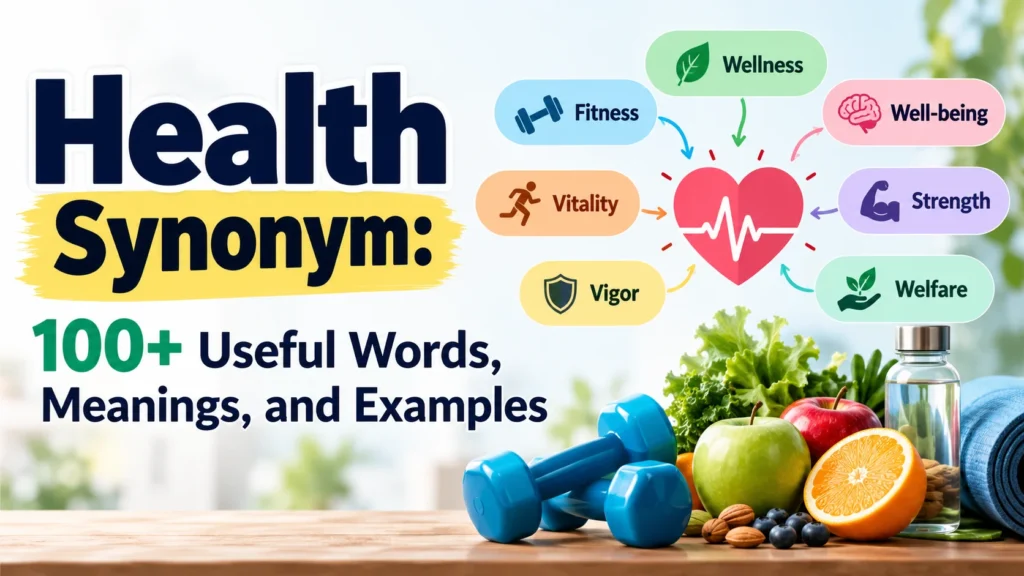
Looking for a health synonym can be surprisingly tricky. The word health has several meanings, so the best alternative depends on what you want to say. Sometimes you may mean physical condition. In other cases, you may be talking about mental well-being, fitness, energy, or a person’s overall welfare.
Common alternatives include wellness, well-being, fitness, vitality, vigor, condition, soundness, strength, and welfare. However, these words do not always have exactly the same meaning. For example, fitness mainly refers to physical ability, whereas well-being can include mental and emotional welfare. Similarly, vitality focuses more on energy and liveliness than general health.
This guide explains the most useful health synonyms and shows how to use them naturally. You will find simple definitions, contextual alternatives, example sentences, formal options, related words, antonyms, and comparisons between commonly confused terms. As a result, you can choose a word that fits your sentence instead of replacing health with an unsuitable alternative.
What Does Health Mean?
Health means the overall condition of a person in relation to physical or mental well-being. The word can describe how well someone is functioning or whether they are affected by illness or disease.
For example, someone might say:
- Regular exercise can improve your health.
- The doctor asked about her general health.
- Good mental health supports everyday well-being.
- A balanced diet can contribute to better health.
The meaning can also extend beyond people. For instance, writers often discuss the health of an economy, the health of a business, or the health of an ecosystem. In these situations, health refers to the condition, stability, strength, or performance of something.
Therefore, you should consider the context before choosing a synonym.
Best Synonyms for Health
Several words can express an idea similar to health. Nevertheless, each alternative emphasizes something slightly different.
| Synonym | Meaning | Best Context | Tone |
|---|---|---|---|
| Wellness | A healthy state and lifestyle | Healthy living | Neutral |
| Well-being | Overall welfare and comfort | General welfare | Neutral |
| Fitness | Physical ability and condition | Exercise | Neutral |
| Vitality | Energy and liveliness | Energetic health | Positive |
| Vigor | Strength and energy | Physical strength | Positive |
| Condition | Current state | Medical contexts | Neutral |
| Soundness | Good or stable condition | Formal writing | Formal |
| Strength | Physical power | Recovery and ability | Neutral |
| Welfare | General welfare and safety | Social contexts | Formal |
| Robustness | Strength and resilience | Systems and organizations | Formal |
1. Wellness
Wellness is one of the closest alternatives to health, especially when the discussion involves lifestyle choices. It often covers physical, mental, and emotional well-being.
Unlike the general word health, wellness can suggest an active effort to maintain a healthy lifestyle. For example, exercise, nutritious food, adequate sleep, and stress management can all form part of a wellness routine.
Example:
The company created a wellness program to support employee well-being.
Best used when: discussing healthy habits, prevention, self-care, or lifestyle improvement.
2. Well-Being
Well-being describes a person’s general state of comfort, health, safety, and happiness. It can cover physical, mental, emotional, and social aspects of life.
In many contexts, this term is broader than health. For example, someone’s emotional well-being can be affected by relationships, work, finances, or their surroundings.
Example:
Spending time outdoors can improve emotional well-being.
Best used when: discussing broad physical, emotional, mental, or social welfare.
3. Fitness
Fitness generally refers to physical condition and the ability to perform activities effectively. As a result, it is particularly useful when exercise or physical performance is the main topic.
Strength, endurance, flexibility, and cardiovascular ability can all relate to fitness.
Example:
Swimming regularly can improve cardiovascular fitness.
Best used when: discussing exercise, training, sports, physical ability, or endurance.
4. Vitality
Vitality means energy, liveliness, and physical or mental strength. It can therefore describe someone who appears energetic and active.
The word has a more positive and expressive tone than the neutral term health. It works especially well when energy is the main quality being described.
Example:
The new routine helped her regain her vitality.
Best used when: emphasizing energy, liveliness, or strength.
5. Vigor
Vigor refers to physical strength, energy, and force. Although it can relate to good health, the main emphasis is usually on energy and strength.
For example, a person recovering from an illness might gradually regain their vigor.
Example:
After several weeks of recovery, he returned to work with renewed vigor.
Best used when: describing strength, energy, enthusiasm, or recovery.
6. Condition
Condition means the state of a person or thing at a particular time. In medical contexts, it can describe someone’s current health or a particular medical problem.
Unlike health, the word does not necessarily imply that the condition is good.
Example:
The patient’s condition improved after treatment.
Best used when: discussing someone’s current physical or medical state.
7. Soundness
Soundness refers to a state of being healthy, strong, stable, or free from serious problems. It has a more formal tone than health.
Consequently, this word is more common in formal descriptions than in everyday conversation.
Example:
The assessment examined the physical soundness of the athlete.
Best used when: writing formally about physical or mental condition.
8. Strength
Strength means physical power or capacity. It can relate to health, but it does not cover the entire meaning of health.
For instance, someone can regain strength after an illness without immediately returning to full health.
Example:
Gentle exercise helped the patient rebuild strength.
Best used when: discussing physical power, recovery, or capability.
9. Welfare
Welfare refers to a person’s general well-being, safety, and quality of life. It is especially common in social, institutional, governmental, and organizational contexts.
Although welfare and well-being overlap, neither word is a perfect replacement for health in every sentence.
Example:
The organization places the welfare of its staff first.
Best used when: discussing general welfare, safety, or quality of life.
10. Robustness
Robustness describes strength, resilience, or the ability to continue functioning effectively under difficult conditions.
This term is less common for individual health. Instead, it often works better when discussing systems, organizations, economies, or ecosystems.
Example:
Researchers evaluated the robustness of the healthcare system.
Best used when: describing resilience, strength, or stability in a broader system.
Health Synonyms by Context
The meaning you intend should guide your choice of synonym. For that reason, context-based groups can be more useful than a simple list of alternatives.
Synonyms for Physical Health
When you are talking about the body’s condition, useful choices include:
- Fitness
- Physical well-being
- Physical condition
- Vitality
- Vigor
- Strength
- Soundness
Example:
Regular movement can support physical fitness and overall well-being.
Here, fitness focuses on physical ability, while well-being communicates a broader idea.
Synonyms for Mental Health
Mental health needs more specific vocabulary. Suitable alternatives include:
- Mental well-being
- Psychological well-being
- Mental wellness
- Emotional well-being
- Psychological health
Example:
Taking regular breaks can support mental well-being during demanding work.
In contrast, fitness would usually be unsuitable in this context because it mainly refers to physical ability.
Synonyms for General Health
When you mean someone’s overall state, consider:
- Well-being
- Wellness
- General condition
- Soundness
- Welfare
Example:
The doctor asked about her overall well-being before discussing the treatment.
In this case, well-being sounds natural because the sentence concerns a broad state rather than one specific medical issue.
Synonyms for a Healthy Lifestyle
If the topic involves habits, prevention, or daily choices, wellness is often a strong option.
Related expressions include:
- Healthy living
- Healthy lifestyle
- Wellness
- Self-care
- Preventive health
- Holistic well-being
Example:
The wellness program encourages healthy eating and regular physical activity.
As a result, wellness is often more suitable than fitness when several aspects of healthy living are involved.
Synonyms for Energy and Liveliness
Sometimes health is used to describe someone who looks energetic and strong. In that situation, these words may fit better:
- Vitality
- Vigor
- Energy
- Strength
- Robustness
Example:
Despite his busy schedule, he still showed remarkable vitality.
Here, vitality highlights energy rather than simply indicating that the person is healthy.
Formal Synonyms for Health
Formal writing does not always require a replacement for health. Still, certain alternatives can provide greater precision when the context calls for them.
Useful choices include:
- Well-being
- Welfare
- Soundness
- Health status
- Physical condition
- Psychological well-being
- General condition
For example:
The report examines the long-term well-being of the affected population.
The word well-being works well because the sentence addresses a broad population rather than a specific medical diagnosis.
Health Synonyms for Academic Writing
Academic writing usually benefits from precise terminology. Therefore, avoid choosing an unusual synonym simply to make the writing sound sophisticated.
Depending on the subject, useful alternatives include:
- Health status
- Physical well-being
- Mental well-being
- Psychological well-being
- Physical fitness
- Quality of life
- Health condition
Example:
Researchers examined the relationship between physical activity and psychological well-being.
In this sentence, psychological well-being is more precise than a general replacement such as wellness.
Health Synonyms for Professional Writing
The best word changes according to the subject.
When discussing employees, consider well-being, wellness, or physical condition.
For organizations, terms such as strength, stability, performance, and robustness may be more appropriate.
When discussing an economy or industry, strength, stability, and performance can communicate the intended meaning more accurately.
For example:
The report examines the financial health of the company.
A more specific alternative would be:
The report examines the company’s financial stability.
In the second sentence, stability works better because the subject is financial performance rather than physical or mental health.
Positive Alternatives to Health
When you want to describe someone as being in a particularly good state, several words may work.
Wellness emphasizes healthy living. Well-being highlights overall welfare. Vitality focuses on energy and liveliness. Vigor suggests strength and force. Fitness points toward physical capability.
For example:
The athlete’s excellent fitness allowed her to complete the demanding course.
On the other hand:
The older runner’s vitality impressed everyone at the event.
Both sentences describe a positive state, but the emphasis is different.
Words Related to Health
Many words are closely connected with health without being actual synonyms. Recognizing this distinction can help you avoid inaccurate word choices.
Common related terms include:
- Medicine
- Healthcare
- Nutrition
- Exercise
- Fitness
- Wellness
- Recovery
- Prevention
- Treatment
- Hygiene
- Lifestyle
- Therapy
- Care
- Immunity
- Strength
For instance, nutrition is closely related to health because food and nutrients affect the body. Nevertheless, nutrition does not mean health.
Likewise, exercise can support health, but it is an activity rather than a state of well-being.
Health Synonyms vs. Related Words
The following comparison makes the difference easier to understand.
| Word | Relationship to Health | Direct Replacement? |
|---|---|---|
| Wellness | Very close concept | Often |
| Well-being | Very close concept | Often |
| Fitness | Specific aspect of health | Sometimes |
| Vitality | Emphasizes energy | Sometimes |
| Nutrition | Supports health | No |
| Medicine | Healthcare field | No |
| Exercise | Health-related activity | No |
| Recovery | Return toward health | No |
| Treatment | Medical intervention | No |
| Hygiene | Health-supporting practice | No |
For example, well-being can replace health in some sentences. However, exercise cannot normally replace it because exercise refers to an activity.
What Is the Difference Between Health and Wellness?
Health generally describes a person’s physical or mental state. Wellness, by contrast, often describes an active approach to maintaining or improving that state.
Consider these two sentences:
Regular exercise supports good health.
This sentence focuses on the person’s condition.
Regular exercise is part of a healthy wellness routine.
Here, the emphasis shifts toward lifestyle and ongoing habits.
Therefore, wellness is especially useful when discussing prevention, self-care, healthy routines, and lifestyle choices.
What Is the Difference Between Health and Well-Being?
Health often focuses on physical or mental condition, whereas well-being can cover a wider range of life experiences.
Well-being may involve:
- Physical comfort
- Emotional balance
- Mental state
- Social connection
- Safety
- Quality of life
For example:
Flexible working arrangements can improve employee well-being.
The sentence does not necessarily refer to a medical improvement. Instead, it describes a broader improvement in the person’s experience.
What Is the Difference Between Health and Fitness?
Fitness is narrower than health. It usually concerns physical ability, endurance, strength, flexibility, or cardiovascular capacity.
Someone can have good overall health without being highly physically fit. Therefore, these terms should not automatically be treated as exact synonyms.
Consider this example:
Her overall health is good, although she wants to improve her fitness.
Both words work naturally because they describe different aspects of physical well-being.
What Is the Difference Between Health and Condition?
Condition means the state of a person or thing at a particular point in time. In medical writing, it can refer to someone’s current state or a specific medical problem.
For example:
The patient’s condition is improving.
Here, condition describes the current medical state.
By comparison:
Regular exercise can improve overall health.
This sentence refers to a broader state of physical well-being.
Common Antonyms of Health
The opposite of health depends on what aspect of the word you mean. Common contrasting terms include:
- Illness
- Disease
- Sickness
- Poor health
- Unwellness
- Weakness
- Frailty
Illness
Illness refers to a state of being sick or unhealthy.
The illness prevented him from returning to work immediately.
Disease
Disease generally refers to a specific medical disorder or pathological condition.
The treatment is designed to manage the disease.
Sickness
Sickness describes the state of being sick and often sounds more conversational than disease.
She stayed home because of sickness.
Weakness
Weakness means reduced physical or functional strength. Although poor health can cause weakness, the word is not always a direct antonym of health.
The infection left him with temporary weakness.
Example Sentences Using Health Synonyms
Different contexts call for different alternatives. The examples below show how each word can work naturally.
Wellness:
The workplace introduced a wellness program for employees.
Well-being:
Good sleep can contribute to emotional well-being.
Fitness:
Cycling is an effective way to improve physical fitness.
Vitality:
The new routine helped her regain her vitality.
Vigor:
He returned to training with renewed vigor.
Condition:
The athlete’s physical condition improved throughout the season.
Soundness:
The assessment considered the overall soundness of the athlete.
Strength:
Gentle exercise helped him rebuild his strength.
Welfare:
The organization places the welfare of its staff first.
Robustness:
Researchers evaluated the robustness of the healthcare system.
Notice that each example emphasizes a slightly different aspect. As a result, the alternatives are more useful when you understand their specific meanings.
How to Choose the Right Health Synonym
Start by identifying the exact idea behind health. That simple step can prevent many awkward word choices.
Choose wellness when the subject involves healthy habits, lifestyle, or prevention.
Use well-being when you mean broad physical, emotional, mental, or social welfare.
Select fitness when physical ability, exercise, or training is the main focus.
Pick vitality when energy and liveliness matter most.
Use vigor when strength and energy are central to the sentence.
Choose condition when you are describing someone’s current physical or medical state.
Use welfare when the discussion concerns general safety, welfare, or quality of life.
Select soundness for a formal description of good physical or mental condition.
Ultimately, the most effective synonym is the one that preserves the original meaning. A simple word used accurately is better than an uncommon alternative that makes the sentence confusing.
Common Mistakes When Using Health Synonyms
Treating Every Related Word as an Exact Synonym
Words such as nutrition, exercise, and medicine are strongly connected with health. However, they do not mean health.
Choose vocabulary based on meaning rather than association. This approach keeps your writing accurate and natural.
Using Fitness for Every Type of Health
Fitness usually refers to physical ability. Consequently, it may sound incorrect when you are discussing emotional or mental health.
Instead, consider well-being, mental wellness, or psychological well-being when the context requires a broader meaning.
Using Wellness in a Medical Diagnosis
Wellness often has a lifestyle-oriented meaning. In a clinical context, health, condition, or health status may be more precise.
For example:
The doctor is concerned about the patient’s health.
This sentence usually sounds more natural in a medical setting than:
The doctor is concerned about the patient’s wellness.
Replacing Health Mechanically
A synonym should not be inserted merely to avoid repeating the same word. The replacement must match the sentence’s meaning, tone, and grammar.
For instance, vitality cannot replace health naturally in every situation. Similarly, welfare may sound inappropriate when discussing a specific medical diagnosis.
Health Word Forms and Related Expressions
Health is a noun. Several related forms are useful in everyday and professional English.
Common expressions include:
- Good health
- Poor health
- Mental health
- Physical health
- Public health
- Healthcare
- Health condition
- Health status
- Health benefits
- Health risks
- Health improvement
Related forms include:
- Healthy — adjective
- Healthily — adverb
- Healthiness — noun
- Health-related — adjective
For example:
She follows a healthy lifestyle.
Similarly:
The program encourages healthier habits through exercise and nutrition.
Among these forms, healthy is by far the most common adjective in everyday English.
FAQs
What is the best synonym for health?
Well-being and wellness are among the closest general alternatives. However, the best option depends on the sentence. Fitness, vitality, condition, and welfare can be more suitable in specific situations.
What is another word for good health?
Useful alternatives include wellness, well-being, fitness, vitality, vigor, soundness, and robustness. The strongest choice depends on whether you want to emphasize general welfare, physical ability, or energy.
What is a synonym for health and wellness?
Well-being is a strong alternative because it can describe broad physical, mental, and emotional welfare. Depending on the context, fitness, vitality, or healthy living may also work.
What is a formal word for health?
Formal alternatives include well-being, welfare, soundness, health status, and physical condition. The most appropriate option depends on the exact meaning.
Is wellness the same as health?
Not exactly. Health generally describes a person’s physical or mental state, whereas wellness often suggests an active approach to maintaining or improving overall well-being.
What is the opposite of health?
Common contrasting terms include illness, disease, sickness, poor health, and unwellness. The appropriate choice depends on the context.
Is fitness a synonym for health?
Fitness is a partial synonym in some situations, but it is not an exact replacement. Fitness mainly concerns physical ability and condition, while health has a broader meaning.
What is another word for physical health?
Depending on the context, you could use physical fitness, physical well-being, physical condition, soundness, or physical wellness.
Conclusion
The best health synonym depends on the exact meaning you want to communicate. Wellness works especially well for healthy lifestyles, while well-being suits broader physical, mental, and emotional welfare. Meanwhile, fitness focuses on physical ability, and vitality and vigor emphasize energy and strength.
Rather than replacing health automatically, consider the context first. A precise alternative can make your writing clearer, more natural, and more useful. In medical situations, health may still be the strongest choice. Elsewhere, a more specific synonym can communicate the intended idea with greater accuracy.

Ethan Whitmore is a language and vocabulary writer focused on synonyms, antonyms, word meanings, and better word choices. He enjoys making language simple, clear, and useful for everyday writing.