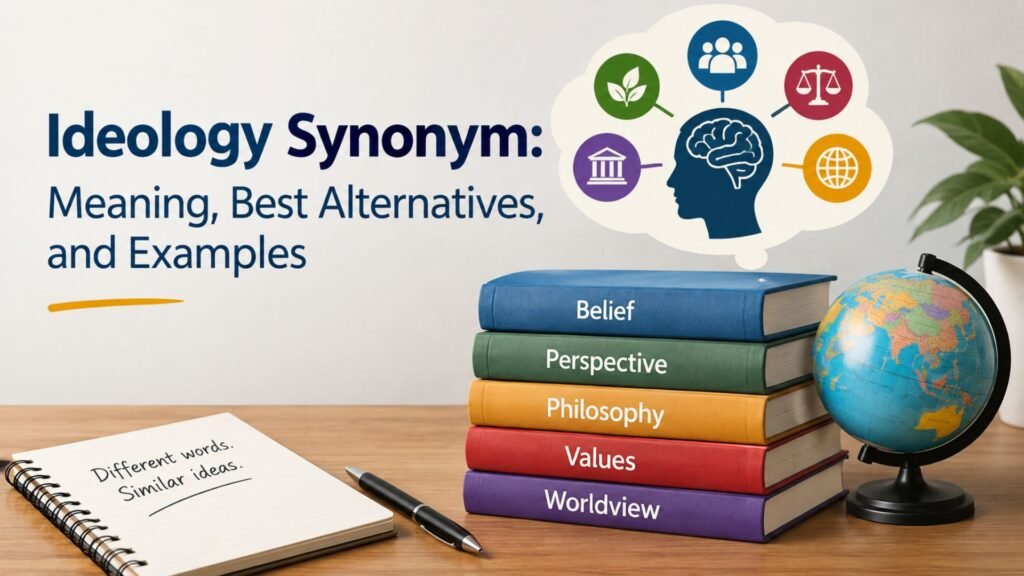
An ideology synonym is a word or phrase that expresses a similar meaning to ideology, which refers to a connected set of beliefs, ideas, or principles held by a person, group, or society. Common alternatives include belief system, philosophy, worldview, doctrine, creed, and school of thought. However, the best choice depends on the context and the meaning you want to communicate.
For example, belief system is a clear, general alternative, while political philosophy is more specific to ideas about government and society. Similarly, doctrine often refers to established principles taught by an organization, whereas worldview describes how someone understands the world. Although these terms overlap, they are not always interchangeable.
Choosing the right alternative can make your writing more precise and natural. In this guide, you’ll discover useful synonyms for ideology, understand their subtle differences, explore examples in different contexts, and learn which words work best in academic, political, professional, and everyday communication.
What Does Ideology Mean?
Ideology is a noun that describes an organized set of ideas, beliefs, values, or principles that shapes how a person or group understands the world and thinks society should work.
The term is especially common in discussions about politics, economics, religion, culture, and social movements. An ideology may influence people’s opinions about government, education, equality, economic systems, or individual freedom.
In simpler terms, an ideology is a collection of related beliefs that helps guide someone’s thinking or actions.
Examples:
- The political party developed an ideology centered on economic equality.
- Her ideology emphasizes cooperation, fairness, and individual responsibility.
- The students examined how ideology can influence public policy.
- Different social movements often reflect different ideologies.
Ideology does not automatically mean an extreme or harmful set of beliefs. The word can be used neutrally in academic writing and everyday discussion. However, it may carry a critical tone when someone suggests that a belief system is rigid, unrealistic, or resistant to evidence.
Best Synonyms for Ideology
The closest synonym for ideology in most general contexts is belief system. Other alternatives, including philosophy, worldview, doctrine, and creed, emphasize different aspects of a person’s or group’s beliefs.
Cambridge English
+1
Here are the most useful options and how to choose between them.
1. Belief System — Noun Phrase
Meaning: A connected collection of beliefs that influences how someone understands life, society, or the world.
Best used when: You want a clear, neutral alternative that works in everyday, academic, and social contexts.
Example: Her belief system emphasizes fairness, education, and equal opportunities.
Difference: A belief system can include religious, personal, cultural, or political convictions. Ideology often has a stronger association with organized social or political ideas.
2. Philosophy — Noun
Meaning: A set of ideas or principles that guides how someone thinks about life, a subject, or a particular problem.
Best used when: Discussing personal values, organizational approaches, education, or political thought.
Example: The school’s educational philosophy encourages curiosity and independent thinking.
Difference: Philosophy can describe a broad approach to life or a field of study. Ideology more often refers to a connected set of beliefs about how society or a system should operate.
3. Worldview — Noun
Meaning: The overall way a person or group understands reality, society, human behavior, and life.
Best used when: Explaining how experiences, culture, or upbringing shape someone’s understanding of the world.
Example: Living in different countries broadened her worldview.
Difference: A worldview emphasizes how someone sees and interprets the world. An ideology often includes more specific principles about how society should be organized.
4. Doctrine — Noun
Meaning: A set of principles or teachings accepted or promoted by a religious, political, or other organization.
Best used when: Discussing established teachings, official positions, or formal systems of belief.
Example: The political movement introduced a doctrine focused on public accountability.
Difference: Doctrine often suggests formal teachings or principles associated with an institution. Ideology can be broader and does not always require an official authority.
5. Creed — Noun
Meaning: A set of beliefs or principles that a person or group strongly accepts.
Best used when: Referring to deeply held religious, moral, or philosophical beliefs.
Example: Respect for human dignity became the foundation of the organization’s creed.
Difference: Creed emphasizes beliefs that people affirm or hold firmly. Ideology generally describes a more extensive system of related ideas.
6. School of Thought — Noun Phrase
Meaning: A particular approach to thinking about a subject, shared by people with similar ideas.
Best used when: Comparing intellectual traditions, academic theories, or competing political approaches.
Example: One school of thought supports gradual economic reform, while another favors more immediate change.
Difference: A school of thought identifies a particular intellectual approach or tradition. It may form part of a wider ideology, but the two terms are not identical.
7. Political Philosophy — Noun Phrase
Meaning: A set of ideas about government, political authority, rights, justice, and the organization of society.
Best used when: Writing about political systems, public policy, citizenship, or government.
Example: The candidate’s political philosophy places strong emphasis on civil liberties.
Difference: Political philosophy specifically concerns political questions. Ideology can also relate to economics, culture, religion, and social life.
8. Principles — Noun
Meaning: Basic rules, values, or beliefs that guide decisions and behavior.
Best used when: Highlighting the standards that influence someone’s actions or an organization’s policies.
Example: The organization follows principles of transparency and fairness.
Difference: Principles are the individual guidelines that may form an ideology. They do not necessarily constitute a complete belief system on their own.
9. Tenets — Noun
Meaning: Core beliefs or principles accepted as part of a particular system of thought.
Best used when: Discussing the fundamental ideas of a movement, religion, philosophy, or theory.
Example: Equality and cooperation are central tenets of the movement.
Difference: Tenets refers to the specific beliefs within a larger system. Ideology describes the overall framework that connects those beliefs.
10. Creed or Credo — Noun
Meaning: A statement or set of beliefs that expresses a person’s or group’s guiding convictions.
Best used when: Emphasizing a guiding belief, mission, or strongly held principle.
Example: The founder’s credo was simple: treat every customer with honesty.
Difference: Credo often refers to a guiding statement or personal conviction, whereas ideology usually covers a broader network of ideas.
11. Dogma — Noun
Meaning: A belief or principle presented as unquestionably true, often with little willingness to consider challenges.
Best used when: Criticizing rigid thinking or beliefs that people refuse to question.
Example: The debate encouraged students to examine assumptions rather than accept them as dogma.
Difference: Dogma often has a negative or critical tone. Ideology can be neutral, so replacing it with dogma changes the meaning of a sentence.
12. Outlook — Noun
Meaning: A person’s general attitude toward life, a situation, or the future.
Best used when: Describing someone’s attitude or general approach rather than a fully developed belief system.
Example: Her optimistic outlook helped the team approach the challenge with confidence.
Difference: An outlook is usually broader and less structured than an ideology. It may describe someone’s attitude without indicating a coherent set of social or political beliefs.
13. Mindset — Noun
Meaning: A habitual way of thinking that influences how someone interprets situations and responds to challenges.
Best used when: Discussing personal development, workplace culture, education, or everyday behavior.
Example: The manager encouraged a collaborative mindset throughout the department.
Difference: Mindset focuses on patterns of thought. It is less suitable than ideology when describing a comprehensive political or social system.
14. Convictions — Noun
Meaning: Strongly held beliefs that a person considers important or true.
Best used when: Emphasizing personal commitment to moral, political, or social beliefs.
Example: Despite criticism, the journalist remained committed to her convictions.
Difference: Convictions highlights the strength of someone’s beliefs. It does not necessarily imply that those beliefs form a complete ideology.
15. Value System — Noun Phrase
Meaning: A connected set of values that influences judgments, priorities, and decisions.
Best used when: Discussing ethics, organizational culture, personal priorities, or social behavior.
Example: The company’s value system emphasizes integrity, responsibility, and customer trust.
Difference: A value system focuses on what a person or group considers important. An ideology may also include explanations of society and proposals for how it should function.
16. Ideals — Noun
Meaning: Standards, goals, or principles that someone considers desirable or worth pursuing.
Best used when: Highlighting aspirations, moral goals, or the values behind a social movement.
Example: The campaign was inspired by ideals of justice and equal opportunity.
Difference: Ideals describe desired standards or outcomes. An ideology is a broader framework that may explain how those outcomes should be achieved.
17. Perspective — Noun
Meaning: A particular way of viewing or interpreting an issue.
Best used when: Discussing different interpretations, opinions, or approaches to a specific subject.
Example: The researcher examined the policy from an economic perspective.
Difference: A perspective may concern just one issue. Ideology generally involves a more connected set of beliefs.
18. Viewpoint — Noun
Meaning: An opinion or position on a particular question or subject.
Best used when: Referring to someone’s stated position in a discussion, debate, or written argument.
Example: The panel included speakers with different viewpoints on education reform.
Difference: A viewpoint can be a single opinion, whereas ideology usually encompasses several related beliefs and principles.
19. Theory — Noun
Meaning: A structured explanation of how something works or why something happens; in broader contexts, it can also refer to a system of ideas.
Best used when: Discussing explanatory models, intellectual frameworks, or ideas about social and political systems.
Example: The researcher compared two theories about how institutions influence public behavior.
Difference: Theory often emphasizes explanation, while ideology typically emphasizes a system of beliefs or principles. The words overlap in some academic and political contexts but are not generally interchangeable.
20. Ethos — Noun
Meaning: The characteristic values, spirit, or guiding principles of a person, organization, or community.
Best used when: Describing an organization’s culture or the values that shape its behavior.
Example: The nonprofit’s ethos is built around service, cooperation, and respect.
Difference: Ethos emphasizes a group’s characteristic spirit and values. Ideology refers more directly to its organized beliefs and ideas.
These alternatives cover many common uses of ideology, from personal beliefs to formal political systems. For further reference, established thesauruses also list terms such as ideas, ideals, principles, and doctrine among the word’s alternatives.
Cambridge English
+1
Ideology Synonyms by Context
The best alternative depends on what you are describing. A political essay may require a more precise term than an everyday conversation, while a workplace discussion may focus on values rather than an entire ideology.
ContextBest alternativesExampleGeneral writingBelief system, philosophyTheir belief system emphasizes fairness.PoliticsPolitical philosophy, doctrineThe party’s political philosophy shapes its policies.ReligionCreed, doctrine, tenetsThe text explains the faith’s central tenets.Academic writingSchool of thought, worldview, theoretical frameworkThe study examines a different school of thought.Personal beliefsConvictions, principles, outlookHer principles guide her decisions.Workplace cultureEthos, philosophy, value systemThe company’s ethos encourages collaboration.Social movementsIdeals, principles, belief systemThe movement’s ideals inspired community action.Critical discussionDogma, rigid belief systemThe writer challenged the group’s dogma.Everyday conversationBeliefs, way of thinking, mindsetWe have different ways of thinking about the issue.
Formal Alternatives to Ideology
For formal reports, academic essays, and professional documents, consider these options:
- Political philosophy: When discussing ideas about government and public life.
- Doctrine: When referring to formal teachings or established principles.
- School of thought: When comparing intellectual approaches.
- Theoretical framework: When describing the organized concepts used to examine a research question.
- Belief system: When a clear, neutral term is more appropriate than specialized vocabulary.
For example, instead of writing, “The report examines the ideology behind the policy,” you could write, “The report examines the political philosophy behind the policy.”
The second sentence is more specific if the discussion concerns political principles. However, if the report examines a broader set of social and economic beliefs, ideology may remain the most accurate choice.
Informal Alternatives to Ideology
In everyday conversation, simpler expressions often sound more natural:
- Beliefs
- Way of thinking
- Mindset
- Personal philosophy
- Outlook
- Point of view
For example:
- Formal: “Their ideologies differ on the role of government.”
- Informal: “They have different views about the role of government.”
The informal version is easier to understand, especially when the discussion concerns a few opinions rather than a complete system of beliefs.
Alternatives for Political Ideology
When writing about politics, the most suitable alternatives include political philosophy, political doctrine, belief system, and school of political thought.
For example, “The movement’s political ideology emphasizes individual rights” could become “The movement’s political philosophy emphasizes individual rights.”
However, avoid replacing political ideology with political opinion if the subject involves an entire system of connected beliefs. An opinion may address one issue, whereas an ideology typically covers a broader set of political principles.
Alternatives for Religious Ideology
When discussing religion, the appropriate word depends on whether you mean a complete system of beliefs or a particular teaching.
- Belief system: A broad set of religious or spiritual beliefs.
- Doctrine: An established religious teaching.
- Creed: A statement or set of accepted beliefs.
- Tenets: The core principles of a faith or tradition.
For example, “The article explains the religious ideology of the community” might become “The article explains the community’s belief system.”
If the article focuses on a specific teaching, however, doctrine may be more precise.
Ideology Synonyms: Comparison Table
Use this table to compare common alternatives at a glance.
SynonymMain meaningToneBest contextBelief systemConnected beliefsNeutralGeneralPhilosophyWay of thinkingNeutralLife, education, politicsWorldviewUnderstanding of the worldNeutralCulture, societyDoctrineEstablished teachingsFormalReligion, politicsCreedStrongly held beliefsFormalReligion, ethicsPrinciplesGuiding rules or valuesNeutralBehavior, decisionsTenetsCore beliefsFormalAcademic, religiousSchool of thoughtShared intellectual approachAcademicResearch, debateMindsetHabitual way of thinkingInformal to neutralWork, personal developmentConvictionsFirmly held beliefsNeutral to strongPersonal values, politicsIdealsDesired standardsPositive in many contextsSocial causes, ethicsDogmaUnquestioned beliefOften negativeCritical discussionEthosCharacteristic values or spiritFormalOrganizations, culturePerspectiveWay of interpreting somethingNeutralAnalysis, discussionOutlookGeneral attitudeNeutralPersonal views, futureValue systemConnected valuesNeutralEthics, culture, business
Remember that these words overlap in meaning without being exact substitutes. For instance, worldview emphasizes understanding, doctrine emphasizes established teachings, and dogma suggests beliefs that are treated as unquestionable.
Ideology vs. Similar Words: Key Differences
Understanding the differences between related words helps you choose the most accurate expression in essays, reports, and everyday communication.
Ideology vs. Philosophy
Both terms can describe connected ideas and principles. However, philosophy has a wider range of uses, including personal approaches to life and the academic study of fundamental questions.
An ideology generally refers to an organized system of beliefs, particularly about society, politics, or economics.
Examples:
- Philosophy: Her philosophy is to solve disagreements through respectful discussion.
- Ideology: The party’s ideology supports a particular approach to economic policy.
Which should you choose? Use philosophy for a general approach to life or a subject. Choose ideology when the focus is a broader system of social, political, or economic beliefs.
Ideology vs. Worldview
A worldview describes how someone interprets reality and understands their place in it. An ideology is often more structured and may include principles about how society should function.
Examples:
- Worldview: His worldview changed after studying different cultures.
- Ideology: The movement’s ideology calls for changes to the education system.
Which should you choose? Use worldview to emphasize understanding and interpretation. Use ideology when discussing an organized framework of beliefs.
Ideology vs. Belief System
These terms are close in meaning, and belief system is often the easiest general substitute for ideology.
However, a belief system can refer to personal, cultural, religious, or spiritual beliefs without necessarily involving a political program.
Examples:
- Belief system: Her belief system was shaped by her family and experiences.
- Ideology: The organization developed an ideology around economic reform.
Which should you choose? Use belief system for broad or personal beliefs. Choose ideology when the beliefs form a more organized framework, especially one related to society or political action.
Ideology vs. Doctrine
A doctrine is a set of principles or teachings that an authority, institution, or movement promotes. Ideology is broader and does not always require formal teachings.
Examples:
- Doctrine: The institution revised its official doctrine.
- Ideology: The movement’s ideology influenced its approach to social reform.
Which should you choose? Use doctrine for established teachings. Use ideology for a broader system of ideas and beliefs.
Ideology vs. Dogma
Although some thesauruses list dogma as a synonym for ideology, the terms have different connotations.
Collins English Thesaurus
+1
Ideology can be neutral, while dogma often implies that a belief is accepted without sufficient questioning.
Examples:
- Ideology: The researcher studied the ideology behind the proposed reforms.
- Dogma: The teacher encouraged students to question assumptions rather than accept them as dogma.
Which should you choose? Use ideology when describing a system of beliefs without automatically criticizing it. Choose dogma when the rigidity of those beliefs is important to your meaning.
Ideology vs. Principles
Principles are individual rules, values, or beliefs that guide decisions. An ideology may contain several principles connected within a broader system.
Examples:
- Principles: The organization follows principles of fairness and transparency.
- Ideology: Its ideology connects those principles to a wider vision of social change.
Which should you choose? Use principles to emphasize particular standards. Use ideology to describe the larger framework that may connect them.
Antonyms of Ideology
Finding an exact antonym for ideology is difficult because ideology describes a system of beliefs rather than a single quality. There is no universally accepted direct opposite. Instead, certain words express contrasting ideas in specific contexts.
1. Skepticism
Meaning: An attitude of questioning claims or withholding acceptance until there is sufficient reason to believe them.
Example: Her skepticism led her to examine the evidence before accepting the political argument.
Relationship to ideology: Skepticism can challenge ideological claims, but a skeptical person may still hold an ideology. Therefore, it is a contextual contrast, not a direct antonym.
2. Pragmatism
Meaning: An approach that emphasizes practical consequences and workable solutions.
Example: The committee chose pragmatism over strict adherence to its original plan.
Relationship to ideology: Pragmatism may contrast with rigid ideological thinking when practical results take priority over established beliefs. However, pragmatic people can also hold ideologies.
3. Objectivity
Meaning: An effort to assess information fairly, using evidence rather than allowing personal preferences to determine the conclusion.
Example: The journalist aimed for objectivity when evaluating the competing political claims.
Relationship to ideology: Objectivity can contrast with a biased presentation of ideological ideas. Nevertheless, ideology and objectivity are not inherently opposites.
4. Empiricism
Meaning: An approach to knowledge that emphasizes observation and experience as sources of evidence.
Example: The scientist relied on empiricism to evaluate the proposed explanation.
Relationship to ideology: Empiricism may contrast with claims based primarily on untested assumptions. However, it is a philosophical approach in its own right, not a direct antonym for ideology.
5. Individualism
Meaning: An outlook that emphasizes the importance, rights, or independence of the individual.
Example: The debate explored individualism and collective responsibility.
Relationship to ideology: Individualism is sometimes contrasted with collectivist ideologies. However, individualism itself can be an ideology, so it should not be presented as the general opposite of the word.
6. Disbelief
Meaning: A lack of acceptance or belief in a particular claim or proposition.
Example: His disbelief in the proposal led him to ask for stronger evidence.
Relationship to ideology: Disbelief contrasts with belief in a particular claim, but it does not necessarily oppose an entire system of beliefs.
Important usage note: Words such as skepticism, pragmatism, objectivity, and disbelief are contextual contrasts rather than exact antonyms. Select the word that describes the specific opposition you intend to express.
Example Sentences Using Ideology Synonyms
The following examples show how different alternatives work in practical situations.
Education
- The teacher explained the philosophy behind the new learning method.
- Students compared two schools of thought about educational reform.
- The university encouraged learners to question established dogma.
- Her worldview broadened after studying international history.
Politics and Society
- The party’s political philosophy influenced its approach to public services.
- The movement’s ideology emphasizes equality and social responsibility.
- Several competing belief systems shaped the public debate.
- The candidate explained the principles guiding the proposed reforms.
Business and Workplace
- The company’s ethos encourages teamwork and accountability.
- The manager introduced a value system centered on transparency.
- Our team’s philosophy prioritizes communication over unnecessary competition.
- A collaborative mindset helped employees resolve disagreements.
Personal Beliefs
- His convictions remained strong despite criticism.
- Her personal philosophy emphasizes kindness and responsibility.
- Their worldviews differed because of their experiences.
- The community’s shared ideals inspired a volunteer project.
These examples demonstrate why choosing a synonym requires attention to context. A word that works well in a political essay may sound unnatural in a personal conversation.
Common Mistakes When Using Ideology Synonyms
Even familiar alternatives can create confusion when writers treat them as interchangeable.
1. Using Dogma as a Neutral Replacement
Dogma often carries a critical meaning, suggesting rigid or unquestioned beliefs.
Less appropriate: “The group developed a dogma about environmental policy.”
More neutral: “The group developed an ideology about environmental policy.”
Use dogma when you specifically want to emphasize unquestioned beliefs, not simply a collection of ideas.
2. Treating an Opinion as a Complete Ideology
An opinion usually concerns a particular question. An ideology generally includes multiple related beliefs.
For example, believing that public transport should cost less is an opinion. A broader system of views about taxation, public services, economic responsibility, and government policy may form part of an ideology.
Consequently, opinion is not always an accurate substitute.
3. Confusing Values With a Belief System
Values describe what someone considers important, such as honesty, fairness, or freedom. A belief system may include those values along with additional ideas about society, human behavior, or reality.
For this reason, values works well when you want to emphasize priorities, but it may be too narrow when describing an entire ideology.
4. Using Formal Vocabulary in Casual Conversations
Words such as doctrine, tenets, and political philosophy can sound unnecessarily formal in everyday situations.
Instead of saying, “I disagree with your ideological framework,” you might say, “I see things differently.”
The simpler expression often communicates the same general disagreement more naturally.
5. Assuming Ideology Always Has a Negative Meaning
In some conversations, ideology is used critically to suggest rigid thinking or political bias. In academic and descriptive writing, however, the term can simply identify an organized set of beliefs.
Therefore, do not replace it with a negative word unless the context supports that judgment.
6. Replacing Ideology With Theory Without Checking the Meaning
A theory generally explains how or why something happens, while an ideology describes a system of beliefs or principles. Although both terms can appear in discussions of politics and society, they serve different purposes.
For example, a theory may explain why a policy produces a particular outcome, whereas an ideology may influence whether a group supports that policy.
Word Forms and Usage of Ideology
Understanding the related forms of ideology can help you use the term correctly in different sentences.
Word formPart of speechMeaningExampleIdeologyNounAn organized system of beliefsThe ideology influenced the movement.IdeologiesPlural nounMultiple systems of beliefsThe debate explored competing ideologies.IdeologicalAdjectiveRelating to an ideologyThey discussed their ideological differences.IdeologicallyAdverbIn a way related to ideologyThe groups are ideologically different.
How to Use Ideology in a Sentence
The noun ideology commonly appears in expressions such as:
- Political ideology: A system of beliefs about politics and government.
- Economic ideology: A set of beliefs about economic systems and policies.
- Social ideology: Ideas about society, social relationships, and social organization.
- Dominant ideology: A system of beliefs that holds a prominent position in a society or institution.
- Competing ideologies: Different systems of beliefs that disagree with one another.
These expressions help make your writing more specific without requiring a synonym.
For example, “The two groups have different ideologies” is grammatically correct but broad. “The two groups have competing economic ideologies” gives readers a clearer idea of the disagreement.
FAQs
What is the closest synonym for ideology?
Belief system is one of the closest general synonyms for ideology. Depending on the context, philosophy, worldview, doctrine, or school of thought may be more precise.
What is a simple word for ideology?
Beliefs or belief system are simple alternatives. You can also use way of thinking when discussing someone’s general approach to an issue.
What is another word for political ideology?
Useful alternatives include political philosophy, political doctrine, and political belief system. The best choice depends on whether you mean a broad set of political beliefs or a specific set of formal teachings.
Is philosophy the same as ideology?
No. Philosophy can describe a general approach to life or a field of study, whereas ideology usually refers to a connected system of beliefs, particularly about politics, society, or economics.
Is dogma a synonym for ideology?
Dogma can overlap with ideology, but it usually suggests beliefs that are accepted without question. Ideology can be neutral, so the words are not interchangeable in every sentence.
What is the opposite of ideology?
There is no single exact antonym for ideology. Depending on the context, skepticism, pragmatism, or objectivity may express a contrasting approach, but none is a universal opposite.
What is the difference between ideology and mindset?
A mindset is a habitual way of thinking, while an ideology is a more organized system of beliefs and principles. A mindset may influence behavior without involving a political or social belief system.
Can ideology be used in a positive sense?
Yes. Ideology can describe beliefs associated with a movement or organization without expressing approval or disapproval. Its tone depends on the context, although it can sometimes be used critically.
Conclusion
The best ideology synonym depends on the meaning you want to convey. Belief system is a reliable general alternative, philosophy emphasizes a way of thinking, worldview focuses on how someone understands the world, and doctrine refers to established teachings. Meanwhile, dogma is more critical, and principles highlights individual guiding beliefs.
Before replacing ideology, consider the context, tone, and scope of your sentence. Choosing a word that preserves the original meaning will make your writing clearer, more natural, and more precise.

Ethan Whitmore is a language and vocabulary writer focused on synonyms, antonyms, word meanings, and better word choices. He enjoys making language simple, clear, and useful for everyday writing.