The word cryptic describes something that is mysterious, unclear, or difficult to understand because its meaning is hidden or not directly expressed. When someone sends a cryptic message, makes a cryptic comment, or gives a cryptic response, they leave others wondering what they really mean. For example, if a friend says, “You’ll understand everything soon,” without offering an explanation, their response might seem cryptic.
Understanding the cryptic meaning can help you recognize hidden messages, interpret confusing statements, and express yourself more precisely. Although words such as mysterious, enigmatic, puzzling, and obscure are closely related, each has a slightly different meaning. Therefore, choosing the right alternative depends on the situation.
In this guide, you’ll discover the definition of cryptic, its pronunciation, useful synonyms and antonyms, and practical example sentences. You’ll also learn how to distinguish cryptic from similar words, understand its use in everyday communication, and avoid common vocabulary mistakes.
What Does Cryptic Mean?
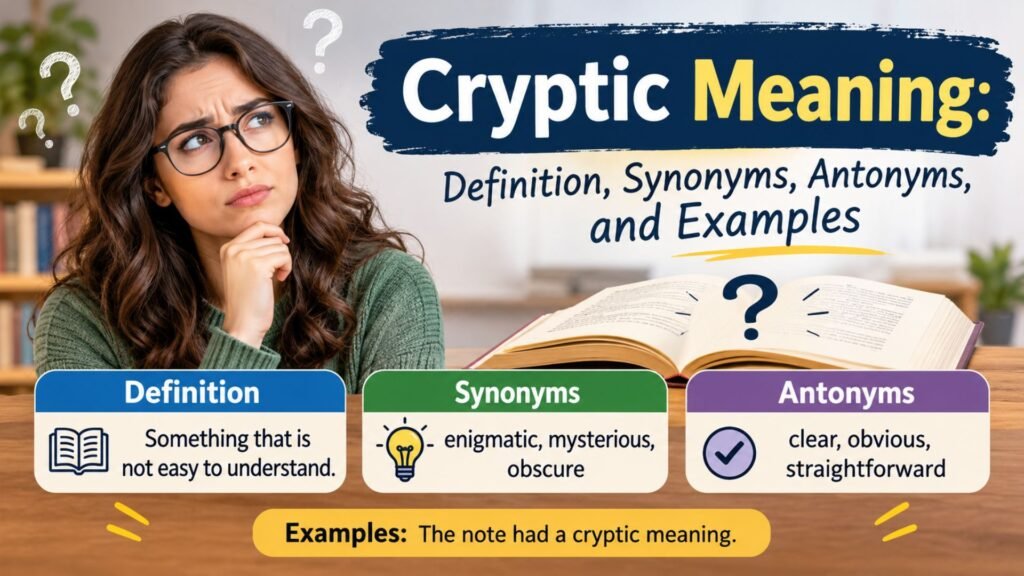
Cryptic means mysterious, puzzling, or difficult to understand because something has a hidden, unclear, or concealed meaning.
In simple terms, something is cryptic when it does not explain itself clearly. Instead, it makes people think, interpret clues, or search for additional information to understand what is being communicated.
For example:
- Cryptic message: A text that contains a hidden or unclear meaning.
- Cryptic comment: A statement that leaves listeners wondering what the speaker intends.
- Cryptic response: An indirect answer that does not clearly explain something.
- Cryptic clue: A puzzle hint that requires careful thinking to solve.
Consider this example:
“Alex received a cryptic email from the manager saying, ‘A major change is coming soon.'”
Here, the email is cryptic because the manager does not explain what the change involves.
However, cryptic does not always mean completely impossible to understand. Sometimes, a message contains enough clues for someone to discover its meaning after careful thought.
According to major English dictionaries, the central meaning of the adjective is having a hidden or difficult-to-understand meaning.
Oxford Learner’s Dictionaries+2
Cryptic Definition and Pronunciation
Word Detail
Explanation
Word
Cryptic
Part of speech
Adjective
Pronunciation
KRIP-tik
IPA
/ˈkrɪp.tɪk/
Syllables
Two
Primary meaning
Mysterious or difficult to understand
Opposite
Clear, obvious, straightforward
Adverb form
Cryptically
The word cryptic is generally pronounced the same way in American and British English.
Simple definition: Something that has a hidden, mysterious, or confusing meaning.
Example: The detective discovered a cryptic note inside the old book.
The word describes the nature of the note rather than the person reading it.
25+ Synonyms for Cryptic
Several English words can replace cryptic, depending on the intended meaning. However, not every alternative communicates exactly the same idea.
For instance, enigmatic suggests something mysterious, while ambiguous describes language that can have more than one interpretation. Similarly, obscure emphasizes a lack of clarity.
Here are useful alternatives with their meanings and examples.
1. Mysterious
Meaning: Something difficult to explain, understand, or identify.
Best used when: Describing unusual events, people, messages, or situations that create curiosity.
Example: A mysterious announcement appeared on the company’s website.
Unlike cryptic, mysterious does not always involve a hidden meaning. It can describe anything that creates uncertainty or curiosity.
2. Enigmatic
Meaning: Mysterious and difficult to interpret or understand.
Best used when: Describing unusual statements, personalities, expressions, or behavior.
Example: Her enigmatic smile made everyone wonder what she knew.
This is one of the closest alternatives to cryptic, particularly when something seems to contain a deeper meaning.
3. Puzzling
Meaning: Confusing or difficult to understand because something does not make sense immediately.
Best used when: Describing situations, explanations, questions, or behavior that require thought.
Example: The scientist discovered a puzzling pattern in the research results.
While cryptic often suggests hidden information, puzzling emphasizes the difficulty of understanding something.
4. Perplexing
Meaning: Causing confusion because something is difficult to explain or understand.
Best used when: Describing complicated problems, unexpected events, or confusing information.
Example: The sudden change in the schedule was perplexing to everyone.
Perplexing is particularly useful when you want to emphasize how confusing something feels.
5. Obscure
Meaning: Not clearly expressed, understood, or easily recognized.
Best used when: Describing unclear explanations, unfamiliar references, or difficult writing.
Example: The article contained several obscure references to historical events.
Unlike cryptic, obscure can also describe something that is little-known or not widely recognized.
6. Ambiguous
Meaning: Having more than one possible meaning or interpretation.
Best used when: Describing statements, instructions, questions, or expressions that can be understood in different ways.
Example: The instructions were ambiguous, so the students interpreted them differently.
An ambiguous statement may be confusing because it allows multiple interpretations. A cryptic statement may instead have one hidden meaning.
7. Vague
Meaning: Not sufficiently clear, detailed, or specific.
Best used when: Describing incomplete explanations, uncertain answers, or general statements.
Example: The company provided a vague explanation of the recent changes.
Vague is usually less mysterious than cryptic because it emphasizes a lack of detail rather than hidden meaning.
8. Secretive
Meaning: Inclined to keep information private or hidden.
Best used when: Describing people, behavior, or activities involving secrecy.
Example: The organization remained secretive about its upcoming plans.
Remember that secretive usually describes someone’s behavior, whereas cryptic more commonly describes the unclear message or expression itself.
9. Coded
Meaning: Expressed through a code or wording that conceals its intended meaning.
Best used when: Describing messages that require special knowledge or interpretation.
Example: The two colleagues exchanged coded messages during the meeting.
A coded message has some form of deliberate encoding, while a cryptic message does not necessarily use a formal code.
10. Inscrutable
Meaning: Extremely difficult or impossible to understand or interpret.
Best used when: Describing expressions, intentions, behavior, or complicated situations.
Example: The professor’s inscrutable expression revealed nothing about his opinion.
Inscrutable is generally stronger and more formal than cryptic.
11. Baffling
Meaning: Extremely confusing or difficult to explain.
Best used when: Describing surprising situations, strange results, or confusing behavior.
Example: The unexpected result was baffling to the entire research team.
12. Mystifying
Meaning: Causing someone to feel confused or unable to understand something.
Best used when: Describing unusual events, statements, or unexplained situations.
Example: His sudden decision was mystifying to his colleagues.
13. Esoteric
Meaning: Understood by only a small group of people with specialized knowledge.
Best used when: Discussing technical subjects, specialized information, or complex ideas.
Example: The lecture included several esoteric references to ancient philosophy.
Esoteric is not an exact synonym because it emphasizes specialized knowledge rather than hidden meaning.
14. Arcane
Meaning: Known or understood by very few people because it is specialized, obscure, or unfamiliar.
Best used when: Describing complicated rules, traditions, or technical knowledge.
Example: The researcher explained several arcane mathematical principles.
15. Unclear
Meaning: Not easy to understand because information is incomplete or poorly explained.
Best used when: Describing instructions, messages, statements, or explanations.
Example: The teacher’s final instructions were unclear to several students.
16. Perplexed
Meaning: Confused or uncertain about something.
Best used when: Describing a person’s reaction rather than the message itself.
Example: Maya looked perplexed after reading the unexpected announcement.
Important: Perplexed describes someone experiencing confusion. Perplexing describes something that causes confusion.
17. Bewildering
Meaning: Extremely confusing or difficult to make sense of.
Best used when: Describing complicated situations, unusual information, or unexpected developments.
Example: The new software presented a bewildering collection of unfamiliar options.
18. Opaque
Meaning: Difficult to understand, explain, or interpret.
Best used when: Describing complicated writing, policies, communication, or explanations.
Example: The report used opaque language that confused its readers.
19. Enigmatical
Meaning: Mysterious or difficult to interpret.
Best used when: Describing something that appears to contain a hidden meaning.
Example: The writer used an enigmatical phrase to create suspense.
This is a less common alternative to enigmatic.
20. Oblique
Meaning: Indirect or not expressed openly.
Best used when: Describing indirect comments, references, or suggestions.
Example: The director made an oblique reference to the upcoming announcement.
21. Veiled
Meaning: Partly hidden or expressed indirectly.
Best used when: Describing disguised criticism, indirect warnings, or concealed intentions.
Example: Her veiled criticism became obvious during the discussion.
22. Cryptical
Meaning: Having a mysterious or hidden meaning.
Best used when: Encountering a less common alternative to cryptic.
Example: The writer included a cryptical remark in the final paragraph.
Cryptical is a valid but much less common form.
23. Unfathomable
Meaning: Extremely difficult to understand or comprehend.
Best used when: Describing complicated ideas, motives, or situations that seem beyond understanding.
Example: The reasons behind the unusual decision remained unfathomable.
24. Incomprehensible
Meaning: Impossible or extremely difficult to understand.
Best used when: Describing information, speech, or explanations that someone cannot understand.
Example: The technical instructions were incomprehensible to beginners.
25. Secret
Meaning: Hidden from general knowledge or kept private.
Best used when: Describing information or details that are intentionally concealed.
Example: The team kept the details of the project secret.
Secret focuses on concealment, whereas cryptic focuses on unclear or hidden meaning.
Best Cryptic Synonyms by Context
Choosing an appropriate alternative depends on what you want to communicate. Some words describe hidden meanings, while others emphasize confusion, indirectness, or secrecy.
The following table makes these differences easier to understand.
Synonym
Main Meaning
Best Context
Enigmatic
Mysterious and difficult to interpret
Expressions and personalities
Mysterious
Difficult to explain
Events and situations
Puzzling
Causing questions or confusion
Problems and statements
Ambiguous
Having multiple meanings
Instructions and language
Obscure
Unclear or little-known
Writing and references
Vague
Lacking specific details
Explanations and answers
Perplexing
Causing confusion
Complicated situations
Coded
Expressed through a code
Secret communications
Inscrutable
Extremely difficult to interpret
Expressions and intentions
Esoteric
Understood by specialists
Academic and technical subjects
Oblique
Indirectly expressed
Comments and references
Veiled
Partly concealed
Criticism and warnings
Formal Synonyms for Cryptic
In professional, academic, or formal writing, some alternatives communicate the intended meaning more precisely.
Consider these options:
- Ambiguous: Suitable for describing statements with multiple interpretations.
- Obscure: Useful for unclear writing or unfamiliar references.
- Inscrutable: Appropriate for something extremely difficult to understand.
- Esoteric: Best for specialized knowledge understood by a limited audience.
- Opaque: Useful for complicated or unclear explanations.
- Oblique: Appropriate for indirect communication.
For example:
Original: “The report contained cryptic explanations.”
More precise: “The report contained opaque explanations.”
The second version emphasizes that the explanations were difficult to understand.
Casual Synonyms for Cryptic
In everyday conversations, simpler alternatives often sound more natural.
Useful choices include:
- Confusing
- Puzzling
- Mysterious
- Unclear
- Strange
- Vague
- Baffling
For example:
“Your reply was cryptic.”
You could say:
“Your reply was confusing.”
The second sentence sounds more conversational and directly communicates the problem.
Antonyms of Cryptic
An antonym is a word that expresses the opposite meaning of another word.
Since cryptic describes something mysterious or difficult to understand, its opposites generally suggest clarity, openness, or simplicity.
Here are some useful antonyms.
Antonym
Meaning
Example
Clear
Easy to understand
Her explanation was clear.
Obvious
Easily recognized or understood
The answer was obvious.
Plain
Simple and understandable
He gave a plain explanation.
Explicit
Expressed clearly and directly
The instructions were explicit.
Straightforward
Easy to understand or deal with
The process was straightforward.
Understandable
Easy to comprehend
The message was understandable.
Transparent
Open and easy to understand
The company provided transparent information.
Direct
Expressed without unnecessary indirectness
She gave a direct answer.
Unambiguous
Having only one clear meaning
The statement was unambiguous.
Lucid
Clear and easy to understand
The teacher offered a lucid explanation.
Direct Antonyms
These words are particularly useful when describing the opposite of a cryptic message or statement.
1. Clear
Something clear communicates its meaning without unnecessary confusion.
Example: The manager gave a clear explanation of the new policy.
2. Explicit
Something explicit expresses information directly and leaves little room for uncertainty.
Example: The contract contained explicit instructions about payment.
3. Straightforward
Something straightforward is simple to understand without complicated explanations.
Example: The teacher provided a straightforward answer to the question.
4. Unambiguous
An unambiguous statement has one clear interpretation rather than several possible meanings.
Example: The revised instructions were unambiguous.
5. Lucid
Lucid describes communication or writing that expresses ideas clearly and logically.
Example: Her lucid explanation helped the students understand the topic.
Contextual Opposites
Some words are opposites of cryptic only in particular situations.
For instance:
- Public: An opposite of secretive information when discussing whether something is concealed.
- Open: An opposite when discussing transparent communication.
- Obvious: An opposite when discussing whether something requires interpretation.
- Understandable: An opposite when discussing how easily someone can interpret a message.
These are contextual opposites rather than interchangeable antonyms in every sentence.
Cryptic vs. Mysterious vs. Ambiguous vs. Vague
Cryptic, mysterious, ambiguous, and vague are closely related. However, using them interchangeably can sometimes change the meaning of a sentence.
Understanding their differences helps you choose more accurate vocabulary.
Word
Main Difference
Example
Cryptic
Has a hidden or difficult-to-understand meaning
He sent a cryptic message.
Mysterious
Creates curiosity or uncertainty
A mysterious visitor arrived.
Ambiguous
Allows multiple interpretations
Her answer was ambiguous.
Vague
Lacks clear details or specifics
He gave a vague explanation.
Cryptic vs. Mysterious
Both words describe something that is not easily understood.
However, cryptic usually focuses on unclear communication or concealed meaning. Mysterious has a broader meaning and can describe people, places, events, and objects.
Cryptic: The author included a cryptic sentence at the end of the chapter.
Mysterious: A mysterious light appeared in the distance.
Cryptic vs. Ambiguous
These words overlap when describing unclear language.
Nevertheless, ambiguous specifically means that something has multiple possible meanings.
Cryptic: The note contained a hidden message that required interpretation.
Ambiguous: The note could be interpreted in two different ways.
Therefore, something can be ambiguous without containing a hidden message.
Cryptic vs. Vague
Both words can describe unclear statements, but they emphasize different problems.
Cryptic suggests hidden meaning or puzzling expression. Vague suggests insufficient detail or precision.
Cryptic: The manager replied with a cryptic statement about the company’s future.
Vague: The manager gave a vague explanation without mentioning any specific dates.
In short, cryptic makes you wonder what something means, while vague makes you wish for more information.
Example Sentences Using Cryptic
The following examples demonstrate how to use the word naturally in different situations.
Everyday Conversation
- My friend sent me a cryptic message that I could not understand.
- His cryptic response made the conversation even more confusing.
- She gave me a cryptic smile but refused to explain why.
- I received a cryptic invitation without any details about the event.
- The strange announcement sounded rather cryptic to everyone.
Education and Academic Writing
- The professor included a cryptic reference in the lecture.
- Students found the poem’s cryptic language difficult to interpret.
- The researcher discovered a cryptic pattern in the collected data.
- Several passages contained cryptic expressions that required further explanation.
- The historical document included a cryptic statement about the royal family.
Workplace and Business
- The director made a cryptic announcement about upcoming organizational changes.
- Employees were confused by the manager’s cryptic email.
- The company released a cryptic statement without explaining its new strategy.
- Her cryptic response left the project team uncertain about the deadline.
- The presentation included a cryptic reference to future developments.
Writing and Literature
- The novelist used cryptic dialogue to create suspense.
- A cryptic sentence at the end of the story encouraged readers to think.
- The mysterious character often spoke in cryptic phrases.
- The poem contained several cryptic references to nature.
- The writer deliberately created a cryptic ending.
Technology and Puzzles
- The computer displayed a cryptic error message.
- The puzzle included a cryptic clue that required careful thinking.
- The programmer struggled to understand the cryptic instructions.
- The game presented players with a series of cryptic symbols.
- Solving the cryptic riddle required attention to small details.
Different Uses of the Word Cryptic
Although cryptic most commonly describes mysterious or unclear communication, it has some additional uses in English.
Understanding these meanings helps you recognize the word in different contexts.
1. Cryptic Messages and Communication
This is the most common everyday use.
A cryptic message communicates something indirectly or leaves its intended meaning unclear.
Example: “Something interesting will happen tomorrow,” she wrote cryptically.
The statement creates curiosity because the speaker does not explain what will happen.
2. Cryptic Crosswords
A cryptic crossword is a type of word puzzle in which clues involve wordplay, definitions, or both.
Unlike ordinary crossword clues, cryptic clues often require solvers to interpret different parts of the wording.
Example: My grandfather enjoys solving cryptic crosswords every weekend.
Here, cryptic describes a particular style of crossword puzzle rather than a confusing conversation.
Oxford Learner’s Dictionaries+2
3. Cryptic Writing
Cryptic writing contains expressions, symbols, or phrases that are difficult to interpret.
Writers may use this style to create suspense, encourage readers to think, or communicate ideas indirectly.
Example: The old manuscript contained cryptic writing that historians struggled to interpret.
4. Cryptic in Biology
In biology, cryptic can describe something that is difficult to notice or identify.
For example, cryptic coloration refers to coloring or patterns that help an organism blend into its surroundings.
Example: The insect’s cryptic coloration helped it blend into the tree bark.
In this context, cryptic relates to concealment rather than confusing language.
Word Forms of Cryptic
Understanding related word forms helps you use this vocabulary correctly in different sentence structures.
Word Form
Part of Speech
Meaning
Example
Cryptic
Adjective
Mysterious or unclear
His message was cryptic.
Cryptically
Adverb
In a mysterious or unclear manner
She answered cryptically.
Cryptical
Adjective
Another form of cryptic
The note contained a cryptical remark.
Cryptically
Cryptically is the adverb form of cryptic.
It describes how someone communicates or how something is expressed.
Examples:
- He cryptically mentioned an upcoming surprise.
- The author cryptically hinted at the ending.
- She answered cryptically when asked about her plans.
Cryptical
Cryptical is an alternative adjective form of cryptic. However, cryptic is considerably more common in modern English.
For most everyday, academic, and professional writing, choose cryptic.
Common Expressions and Phrases With Cryptic
Certain expressions frequently use cryptic to describe mysterious communication or hidden information.
Here are some useful combinations.
Expression
Meaning
Example
Cryptic message
A message with a hidden or unclear meaning
I received a cryptic message last night.
Cryptic remark
A mysterious or confusing comment
His cryptic remark surprised everyone.
Cryptic clue
A puzzle hint requiring interpretation
The cryptic clue was difficult to solve.
Cryptic response
An unclear or indirect answer
She gave a cryptic response.
Cryptic smile
An expression suggesting a hidden thought
He greeted us with a cryptic smile.
Cryptic statement
A statement that is difficult to interpret
The spokesperson issued a cryptic statement.
Cryptic language
Language that is mysterious or difficult to understand
The novel uses cryptic language.
Cryptic warning
A warning with an unclear or hidden meaning
They received a cryptic warning.
These expressions are useful in storytelling, journalism, everyday communication, and descriptive writing.
Common Mistakes When Using Cryptic
Although cryptic is a relatively straightforward adjective, learners sometimes confuse it with similar vocabulary.
Here are several mistakes worth avoiding.
1. Treating Cryptic and Ambiguous as Identical
Both words describe unclear communication. However, ambiguous specifically suggests multiple possible interpretations.
Incorrect assumption: Every cryptic message must have multiple meanings.
Correct understanding: A cryptic message may have one hidden meaning that the reader has not yet discovered.
2. Confusing Cryptic With Vague
A vague statement lacks specific information. In contrast, a cryptic statement may contain information that is difficult to interpret.
For example:
- Vague: “The meeting will happen sometime soon.”
- Cryptic: “The meeting will change everything.”
The first statement lacks details. The second creates curiosity about an unstated meaning.
3. Using Cryptic to Describe Every Difficult Subject
Cryptic is not the best choice for every complicated topic.
For example, an advanced mathematical explanation may be complex or difficult rather than cryptic.
Use complex when something contains many connected parts. Choose cryptic when its meaning is hidden or difficult to interpret.
4. Confusing Cryptic and Cryptically
Cryptic is an adjective, whereas cryptically is an adverb.
Incorrect: She replied in a cryptic manner and spoke cryptic.
Correct: She replied cryptically.
Another correct option is: She gave a cryptic response.
5. Assuming Every Cryptic Message Is Secret
A cryptic message is not necessarily confidential or deliberately encoded.
Sometimes, someone simply communicates indirectly without realizing how confusing their words sound.
Therefore, cryptic and secret are related but not interchangeable.
FAQs
1. What does cryptic mean in simple words?
Cryptic means mysterious, confusing, or difficult to understand because the meaning is hidden or unclear. For example, an unexplained message containing an unusual statement can be described as cryptic.
2. Is cryptic positive or negative?
Cryptic is generally neutral. However, its meaning depends on the situation.
A cryptic message can create excitement and curiosity. On the other hand, cryptic instructions may frustrate people who need clear information.
3. What is another word for cryptic?
Some common alternatives include mysterious, enigmatic, puzzling, perplexing, obscure, ambiguous, and vague. The best choice depends on whether you want to emphasize hidden meaning, confusion, or a lack of clarity.
4. What is the opposite of cryptic?
Common antonyms include clear, obvious, straightforward, explicit, lucid, and unambiguous. These words describe information that is easy to understand or interpret.
5. Does cryptic mean secret?
Not exactly. Cryptic means difficult to understand or having a hidden meaning, while secret means information that is deliberately kept private. A cryptic message may contain a secret, but the two words have different meanings.
6. What is a cryptic message?
A cryptic message is a written or spoken communication that has an unclear, mysterious, or hidden meaning. It often requires additional thought or interpretation to understand.
7. What does cryptic mean in texting?
In texting, cryptic describes a message that is indirect, mysterious, or difficult to interpret. For example, a text saying “You’ll find out soon” without further explanation may seem cryptic.
8. What is the difference between cryptic and enigmatic?
Both words describe something mysterious or difficult to understand. However, enigmatic often emphasizes something that inspires curiosity, while cryptic commonly suggests hidden or unclear meaning in communication.
Conclusion
Understanding the cryptic meaning helps you describe messages, statements, expressions, and situations that contain hidden or difficult-to-understand meanings. Words such as mysterious, enigmatic, puzzling, and obscure provide useful alternatives, although each has its own nuance.
Similarly, antonyms such as clear, explicit, straightforward, and unambiguous help express the opposite idea.
Ultimately, choose cryptic when something seems to conceal its meaning or requires interpretation. For everyday writing, remember that the best synonym is not necessarily the most complicated word. It is the one that communicates your intended meaning accurately and naturally.

Ethan Whitmore is a language and vocabulary writer focused on synonyms, antonyms, word meanings, and better word choices. He enjoys making language simple, clear, and useful for everyday writing.