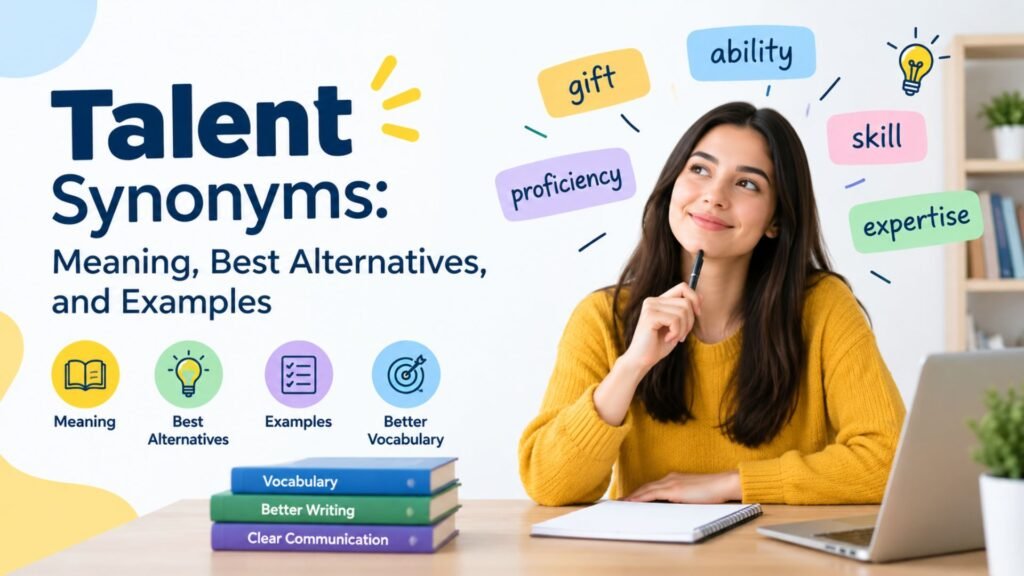
The best synonym for talent depends on what you want to express. If you mean a natural ability to do something well, words such as gift, aptitude, knack, and flair are useful alternatives. However, if you are describing a person’s professional abilities, skill, expertise, and proficiency may communicate the idea more accurately.
Understanding talent synonyms helps you choose words that fit the situation. For example, a person may have a natural gift for music, develop strong skills through practice, or demonstrate expertise after years of professional experience. Although these expressions are related, each one highlights a slightly different quality.
In this guide, you will discover the most useful synonyms for talent, their meanings, and examples of how to use them correctly. You will also learn which alternatives work best in academic writing, professional communication, everyday conversation, and descriptions of exceptional ability. In addition, the guide explains the difference between talent and similar words, explores relevant antonyms, and answers common vocabulary questions.
What Does Talent Mean?
Talent is a noun that describes a natural ability to perform an activity well. It often refers to an ability that a person can develop further through learning, practice, and experience.
For example, someone may show a talent for painting, solving mathematical problems, playing an instrument, or explaining difficult ideas. Talent can appear in creative, academic, physical, social, and professional activities.
The word also has another common meaning: a talented person or a group of skilled people. In business, for instance, talent often refers to employees or potential employees whose abilities are valuable to an organization.
English meaning – Cambridge Dictionary
+1
Consider these examples:
- Natural ability: Maya has a talent for writing engaging stories.
- Developed ability: His musical talent improved with regular practice.
- A talented person: The theater company welcomed several promising new talents.
- Professional workforce: The organization invests in attracting and retaining talent.
Although people sometimes use talent and skill interchangeably, they are not identical. Talent often emphasizes natural aptitude, while skill highlights the ability to perform a task, usually through learning or practice. Both can work together to produce excellent results.
Best Talent Synonyms
The most useful alternatives depend on the intended meaning, tone, and context. The following words cover natural abilities, learned skills, special strengths, and exceptional performance.
SynonymMeaningBest Used WhenGiftA special natural abilityDescribing an impressive natural qualityAptitudeA natural ability or readiness to learnDiscussing potential or suitabilityFlairA distinctive and natural abilityDescribing creativity or styleKnackAn ability to do something easilyCasual conversation and practical tasksAbilityThe power or skill to do somethingGeneral-purpose writingSkillAn ability developed or improved through practiceWork, education, and practical activitiesExpertiseAdvanced knowledge and skillProfessional or technical contextsProficiencyA high level of competenceLanguages, tools, and specific tasksForteA person’s particular strengthHighlighting a strong areaGeniusExceptional intellectual or creative abilityDescribing extraordinary abilityCapacityThe ability or potential to do somethingDiscussing potential or capabilityStrengthAn area in which someone performs wellPersonal development and performanceFacultyA particular mental or physical abilityFormal or specialized writingFacilityEase and natural ability in performing somethingLanguages, movement, or mental tasksEndowmentA natural quality or abilityFormal descriptions of inherent abilities
These alternatives overlap with talent, but each adds a different shade of meaning. For example, aptitude emphasizes potential, expertise points to developed knowledge, and flair often suggests creativity or style.
Collins English Dictionary
+2
Detailed Talent Synonyms With Meanings and Examples
1. Gift — Noun
Meaning: A special ability that seems natural rather than entirely learned.
Best used when: You want to emphasize an impressive or distinctive natural ability.
Example: Amira has a gift for explaining complicated scientific ideas in simple language.
A gift often suggests that an ability comes naturally. However, the word does not mean that practice is unnecessary. Someone with a gift for music may still need years of training to become an accomplished musician.
2. Aptitude — Noun
Meaning: A natural ability or readiness to learn a particular activity.
Best used when: Discussing potential, learning, education, or career suitability.
Example: Daniel showed a strong aptitude for computer programming during his first semester.
Unlike talent, which often describes an ability already demonstrated, aptitude can emphasize the likelihood of learning or succeeding at something. For this reason, it works especially well in educational and career discussions.
3. Flair — Noun
Meaning: A natural ability to do something in an appealing, original, or stylish way.
Best used when: Describing creativity, presentation, design, writing, or communication.
Example: The designer has a flair for combining simple colors in memorable ways.
Although flair and talent are similar, flair often suggests a distinctive personal style. A person may have a flair for storytelling because they know how to make ordinary events engaging.
4. Knack — Noun
Meaning: A special ability to do something easily or effectively.
Best used when: Talking about practical abilities in everyday conversation.
Example: Leo has a knack for finding solutions when a group project becomes complicated.
Knack sounds more conversational than aptitude or proficiency. It often describes a particular ability rather than broad excellence across an entire subject.
5. Ability — Noun
Meaning: The power, competence, or capacity to perform an action.
Best used when: You need a broad, neutral alternative that works in most situations.
Example: Her ability to organize complex projects makes her a dependable team member.
Ability is one of the most flexible alternatives to talent. It can refer to natural qualities, learned skills, or a combination of both. Therefore, it is useful in academic essays, professional reports, and everyday conversation.
6. Skill — Noun
Meaning: The ability to perform an activity well, often developed through learning and practice.
Best used when: Emphasizing training, experience, technique, or demonstrated performance.
Example: Consistent practice helped the young musician turn an early interest into a valuable skill.
While talent may provide a starting advantage, skill often reflects what someone can do after learning and practice. The two terms are closely related, but replacing talent with skill shifts the emphasis toward performance and development.
7. Expertise — Noun
Meaning: A high level of specialized knowledge, experience, and skill.
Best used when: Writing about professional, technical, scientific, or academic competence.
Example: The project succeeded because the research team combined its technical expertise with careful planning.
Expertise is not an exact synonym for natural talent. Instead, it usually indicates substantial knowledge or experience in a particular field. Use it when you want to communicate professional competence rather than an inborn ability.
8. Proficiency — Noun
Meaning: A high degree of competence in a particular activity or subject.
Best used when: Describing language ability, technical skills, software knowledge, or other measurable competencies.
Example: Her proficiency in three languages helped her communicate with international clients.
Unlike flair, which often implies creativity, proficiency emphasizes the ability to perform a task competently. It is especially useful in résumés, educational assessments, and professional profiles.
9. Forte — Noun
Meaning: A particular subject, activity, or quality at which someone excels.
Best used when: Identifying a person’s strongest area.
Example: Public speaking is his forte, so he volunteered to present the team’s findings.
The word forte is useful when someone has several abilities but performs especially well in one area. For instance, research may be one student’s forte, while creative writing may be another’s.
10. Genius — Noun
Meaning: Exceptional intellectual, creative, or inventive ability.
Best used when: Describing extraordinary achievement or unusually impressive ability.
Example: Her inventive approach to the design problem demonstrated remarkable creative genius.
Genius is much stronger than ordinary talent. Using it for a routine ability may sound exaggerated. Reserve it for contexts where exceptional originality, intelligence, or achievement is genuinely intended.
11. Capacity — Noun
Meaning: The ability or potential to understand, perform, achieve, or develop something.
Best used when: Discussing potential, readiness, or the ability to handle a task.
Example: The new student showed a remarkable capacity for learning unfamiliar concepts.
Capacity can describe something broader than an established talent. For example, a person may have the capacity to become an excellent researcher even before developing advanced research skills.
12. Strength — Noun
Meaning: A quality, subject, or activity in which someone performs particularly well.
Best used when: Discussing personal development, teamwork, performance reviews, or academic abilities.
Example: Careful analysis is one of Priya’s greatest strengths.
Unlike gift, which often emphasizes natural ability, strength can include qualities developed over time. It can also refer to interpersonal qualities, such as patience, organization, and clear communication.
13. Faculty — Noun
Meaning: A particular mental or physical ability, such as memory, judgment, or perception.
Best used when: Writing formally about a specific human ability.
Example: The task required a strong faculty for observation and careful reasoning.
Faculty is more formal than talent and appears less often in ordinary conversation. It also has other meanings, including a group of teachers at a university, so context matters.
14. Facility — Noun
Meaning: Ease or natural ability in performing a particular activity.
Best used when: Describing someone who handles a task with apparent ease.
Example: His facility with written language made editing complex documents seem effortless.
The phrase facility with languages is a natural example of this usage. However, facility also means a building or place used for a particular purpose, so it should be chosen carefully.
15. Endowment — Noun
Meaning: A natural quality, ability, or characteristic that a person possesses.
Best used when: Describing inherent qualities in formal or literary writing.
Example: Her intellectual endowment helped her approach difficult questions with originality.
Endowment has a more formal tone than gift or knack. It can also refer to money or assets provided to an institution, so the intended meaning should be clear from the sentence.
Talent Synonyms by Context
Choosing the right alternative becomes easier when you consider where and why you are using it. A word that sounds natural in a conversation may feel too casual in an academic paper, while a formal term may make everyday writing unnecessarily complicated.
Formal Synonyms for Talent
For professional documents, reports, and formal communication, choose words that describe ability clearly and accurately.
- Aptitude: A natural readiness or potential for a particular activity.
- Proficiency: A demonstrated level of competence.
- Expertise: Advanced knowledge and experience in a field.
- Capability: The ability to perform a task or achieve a result.
- Competence: The ability to meet the requirements of a task or role.
- Acumen: Sharp judgment or insight, especially in business or practical decision-making.
- Facility: Ease in performing a particular activity.
Example: Instead of writing, “The candidate has a lot of talent in data analysis,” you could write, “The candidate demonstrates strong analytical proficiency.”
The second sentence is more specific because it identifies the type of ability being discussed. Similarly, expertise would be appropriate if the candidate has advanced knowledge and substantial experience.
Casual Synonyms for Talent
Everyday conversation often benefits from simpler, more natural expressions.
- Knack: A particular ability that seems easy to use.
- Gift: A special natural ability.
- Thing: An informal expression for something a person does especially well.
- Flair: A distinctive style or creative ability.
- Strength: An area where someone performs well.
- Way with: A phrase describing a special ability to interact with someone or handle something.
Examples:
- “She has a knack for remembering names.”
- “Cooking is his thing.”
- “Mina has a real flair for decorating rooms.”
- “Our teacher has a way with words.”
These expressions do not all have the same tone. For example, thing is very informal, while gift works in both casual and more polished writing.
Academic Synonyms for Talent
In essays, research discussions, and educational writing, the best word depends on whether you mean potential, demonstrated ability, or exceptional performance.
WordAcademic UseExampleAptitudeNatural potentialThe student demonstrated an aptitude for scientific reasoning.CapabilityAbility to perform a taskThe experiment assessed the participants’ capability to solve unfamiliar problems.ProficiencyDemonstrated competenceThe assessment measured proficiency in academic writing.CompetenceAbility to meet a standardThe course develops competence in statistical analysis.CapacityPotential to learn or achieveThe findings suggest a capacity for independent learning.AcumenSharp judgment or insightHer financial acumen informed the research team’s decisions.
For academic work, precision matters more than choosing an impressive-sounding word. Use aptitude when discussing potential, proficiency when describing an achieved level of ability, and capacity when emphasizing what someone may be able to do.
Professional Synonyms for Talent
In workplace communication, talent can describe both an individual’s abilities and a group of skilled employees. Nevertheless, a more specific word may improve a job description, résumé, or performance review.
- Expertise: Specialized knowledge and experience.
- Competence: The ability to perform a role effectively.
- Proficiency: Strong performance in a particular task or tool.
- Capability: The ability to complete work or achieve an objective.
- Strength: An area of particularly good performance.
- Acumen: Sound judgment in a specific area, such as business or finance.
For example, “The company needs talented employees” is understandable, but “The company needs employees with strong technical expertise” identifies the required qualification more clearly.
When describing people collectively, however, talent remains a natural term. Expressions such as talent acquisition, talent development, and talent management are established business terms.
English meaning – Cambridge Dictionary
+1
Synonyms for Exceptional Talent
Sometimes, ordinary words do not fully communicate the level of ability you want to describe. In these cases, stronger alternatives can help, provided they accurately reflect the situation.
- Genius: Exceptional intellectual or creative ability.
- Brilliance: Outstanding intelligence, insight, or performance.
- Virtuosity: Extraordinary technical skill, especially in music or the arts.
- Mastery: A very high level of control or competence.
- Giftedness: The quality of having notable natural abilities.
- Excellence: A high standard of achievement or performance.
Examples:
- The pianist displayed remarkable virtuosity during the concert.
- Her mastery of the subject was evident in the detailed presentation.
- The scientist’s brilliance helped the team develop an original solution.
These terms are not interchangeable in every situation. Virtuosity is especially suitable for impressive technical performance, whereas mastery emphasizes a high level of control or knowledge. Likewise, excellence describes the quality of performance rather than simply a natural gift.
Talent Synonyms for Different Types of Ability
The most effective synonym often depends on the kind of talent being described. Grouping alternatives by ability makes it easier to choose an accurate word.
Creative Talent
For abilities involving art, music, design, storytelling, or original ideas, consider:
- Creativity: The ability to generate original or imaginative ideas.
- Flair: A natural sense of style or creative expression.
- Gift: A special natural ability.
- Artistry: Creative skill and expressive quality in an art form.
- Inventiveness: The ability to develop new ideas or approaches.
- Imagination: The ability to form original mental images or ideas.
Example: The young illustrator combines imagination and artistry to create memorable characters.
Although these words relate to creative talent, they emphasize different qualities. Creativity focuses on generating ideas, while artistry highlights skill and expression in an artistic activity.
Intellectual Talent
For academic, analytical, or problem-solving abilities, useful alternatives include:
- Intelligence: The ability to learn, understand, and reason.
- Acumen: Sharp judgment and insight.
- Aptitude: Natural potential in a particular area.
- Brilliance: Exceptional intellectual ability or insight.
- Analytical ability: The capacity to examine information and draw conclusions.
- Ingenuity: Skill in finding clever or original solutions.
Example: His analytical ability helped him identify a pattern that others had overlooked.
In this context, ingenuity is especially useful when someone finds a clever solution. Meanwhile, aptitude works better when you want to emphasize potential rather than an already demonstrated achievement.
Social and Communication Talent
Some abilities involve working with people, explaining ideas, or building relationships. Suitable alternatives include:
- Communication skills: The ability to convey information clearly.
- Diplomacy: The ability to handle sensitive situations tactfully.
- Charisma: A quality that attracts or influences other people.
- Eloquence: The ability to express ideas fluently and persuasively.
- Interpersonal skills: The abilities needed to interact effectively with others.
- Persuasiveness: The ability to influence opinions through communication.
Example: Her diplomacy helped resolve the disagreement without damaging the team’s working relationships.
These words describe different aspects of social ability rather than exact synonyms for talent. For instance, charisma concerns personal appeal, while diplomacy emphasizes tact and careful handling of difficult situations.
Practical and Physical Talent
For sports, crafts, coordination, and hands-on activities, consider:
- Dexterity: Skill in performing precise movements, especially with the hands.
- Coordination: The ability to control movements or organize actions effectively.
- Agility: The ability to move quickly and easily.
- Craftsmanship: Skill and care in making things.
- Technique: A particular method or way of performing an activity.
- Knack: An ability to handle a task effectively.
Example: The craftsperson’s dexterity allowed them to create intricate designs with precision.
Although agility and coordination can describe abilities, they refer to particular physical qualities. Use them only when those qualities are relevant to the intended meaning.
Talent vs. Similar Words: What Is the Difference?
Several English words overlap with talent, but their meanings are not identical. Understanding these differences helps you avoid awkward substitutions.
WordMain DifferenceExampleTalentOften emphasizes natural abilityShe has a talent for music.SkillEmphasizes the ability to perform a task, often through practiceShe developed her piano skills through lessons.GiftSuggests a special natural abilityHe has a gift for storytelling.AptitudeHighlights natural potential or readiness to learnShe has an aptitude for mathematics.AbilityA broad term for being able to do somethingHe has the ability to lead a team.ExpertiseEmphasizes advanced knowledge and experienceShe has expertise in cybersecurity.GeniusSuggests exceptional intellectual or creative abilityHis work showed unusual creative genius.FlairHighlights style or a distinctive natural approachShe has a flair for interior design.KnackDescribes a particular ability that comes easilyHe has a knack for fixing technical problems.StrengthIdentifies an area where someone performs wellClear communication is one of her strengths.
Is Talent the Same as Skill?
No. Talent often refers to natural ability, whereas skill usually refers to the ability to perform a task well, frequently through practice or instruction.
For example, a child may show an early talent for drawing. As that child studies technique and practices regularly, their drawing skills may improve.
However, the distinction is not absolute. People sometimes use talent to describe abilities developed over time, and some skills may come naturally to certain individuals. Both qualities can contribute to achievement.
Is Talent the Same as Aptitude?
Not exactly. Aptitude often emphasizes potential or readiness to learn, while talent usually describes a notable ability that a person already demonstrates.
For example, a student may have an aptitude for engineering before gaining practical experience. After completing projects and developing technical abilities, the student may demonstrate talent in a particular engineering field.
Is Gift Stronger Than Talent?
Neither word is always stronger than the other. Gift often gives more emphasis to natural ability, while talent is a broader term that can describe an ability that is developed and demonstrated over time.
For example, “a gift for music” highlights natural ease, while “musical talent” can refer to both natural ability and the abilities a musician has developed.
When Should You Use Expertise Instead of Talent?
Use expertise when you want to emphasize specialized knowledge and experience rather than natural potential.
For instance, a person may have a talent for solving problems but lack professional experience. Another person may have expertise in solving a specific class of problems because of years of study and practice.
Consequently, expertise is usually more precise when describing advanced professional or technical knowledge.
Antonyms of Talent
An antonym is a word that expresses the opposite of another word. Because talent describes natural ability or a person’s special strengths, its opposites usually refer to an inability, a lack of competence, or difficulty performing a task.
There is no single antonym that works perfectly in every context. The best choice depends on whether you mean a lack of natural aptitude, poor performance, or insufficient experience.
AntonymMeaningExampleInabilityLack of ability to do somethingHis inability to solve the problem prompted him to seek help.IneptitudeLack of skill or competenceThe report highlighted serious ineptitude in project planning.IncompetenceFailure to meet the required standard of competenceThe task required training to address gaps in competence.IneptnessLack of skill or effectivenessHer early ineptness with the software disappeared after practice.WeaknessAn area of limited ability or performancePublic speaking was initially his main weakness.InexperienceLack of practical knowledge or experienceHer inexperience made the unfamiliar task more challenging.Lack of aptitudeLimited natural readiness for a particular activityA lack of aptitude for one subject does not prevent someone from succeeding in another.MediocrityA level of quality that is ordinary rather than exceptionalThe team aimed for excellence rather than mediocrity.
Important distinction: Inability is a more direct opposite of ability, while inexperience does not mean someone lacks talent. A beginner may have considerable natural potential but still need time to develop practical skills.
Similarly, mediocrity describes a level of performance or quality, not the complete absence of talent. Choose the antonym that accurately describes the situation rather than automatically treating every contrasting word as an exact opposite.
Talent Synonyms in Example Sentences
Seeing alternatives in complete sentences can help you understand their meaning and choose the right word when writing.
Everyday Examples
- Ella has a gift for making people feel welcome.
- My brother has a knack for remembering complicated directions.
- Their daughter shows a natural aptitude for mathematics.
- Sam has a real flair for decorating small spaces.
- Cooking is one of my greatest strengths.
- The new student demonstrated an impressive ability to learn unfamiliar concepts.
Academic Examples
- The assessment measured students’ proficiency in written English.
- Her aptitude for scientific reasoning became clear during the course.
- The researcher demonstrated exceptional analytical ability when interpreting the results.
- The program helps learners develop their capacity for independent thinking.
Professional Examples
- The organization values employees with strong technical expertise.
- His financial acumen helped the business make better decisions.
- Clear communication is one of the candidate’s main strengths.
- The company hopes to attract and retain exceptional talent.
- The designer’s creative flair gave the campaign a distinctive identity.
Creative and Artistic Examples
- The singer’s musical gift became apparent at an early age.
- The painter displayed remarkable artistry in the use of light.
- Her inventiveness helped transform an ordinary story into an original performance.
- The pianist demonstrated impressive virtuosity during the concert.
- His mastery of the instrument reflected years of dedicated practice.
Notice how the alternatives change the emphasis of each sentence. For example, expertise communicates professional knowledge, whereas virtuosity emphasizes exceptional technical performance. As a result, choosing the right word can make your writing more precise without changing the central message.
Common Mistakes When Using Talent Synonyms
Even closely related words can create problems when used in the wrong context. Keep these common distinctions in mind.
1. Using Skill and Talent as Exact Equivalents
Although both words describe ability, they emphasize different things.
- Less precise: She has a talent in using spreadsheet software.
- Better: She has a talent for understanding complex data.
- Better for workplace writing: She has strong spreadsheet skills.
The phrase talent for is natural when describing a general ability. However, skills in is often more suitable when listing practical competencies.
2. Confusing Aptitude With Expertise
Aptitude suggests potential or readiness to learn, while expertise implies specialized knowledge and experience.
For example, a beginner may have an aptitude for coding without having the expertise needed to manage a complex software project. Using the correct word prevents you from overstating someone’s experience.
3. Calling Every Ability Genius
Genius is a much stronger term than talent. Calling an ordinary workplace skill genius may sound exaggerated or unclear.
Instead, use expertise, proficiency, or strength when those terms describe the person’s abilities more accurately.
4. Choosing a Formal Word for Casual Conversation
Words such as endowment, faculty, and proficiency can sound overly formal in everyday conversation.
For instance, “She has a natural endowment for jokes” sounds less natural than “She has a knack for making people laugh.” Match the word to your audience and the situation.
5. Treating Inexperience as a Lack of Talent
A person who is new to an activity may need more practice, instruction, or opportunity. That does not necessarily mean they lack natural ability.
For this reason, use inexperience when someone lacks practical exposure and inability only when the context supports a genuine lack of ability.
Word Forms and Grammar of Talent
Understanding the grammatical forms of talent helps you use the word naturally and avoid unnecessary repetition.
Word FormPart of SpeechExampleTalentNounHer talent for writing is impressive.TalentsPlural nounHis many talents include music and design.TalentedAdjectiveShe is a talented illustrator.TalentlesslyAdverbThis is a rare and generally awkward form; use a clearer expression instead.
The most useful related form is talented, an adjective that describes someone who has a notable ability.
For example, instead of writing, “He is a person with talent in photography,” you can write, “He is a talented photographer.”
Common Grammar Patterns
Use these established patterns when writing about talent:
- Talent for + noun: She has a talent for music.
- Talent for + verb ending in -ing: He has a talent for solving puzzles.
- Natural talent: The coach recognized her natural talent.
- Exceptional talent: The competition attracted performers with exceptional talent.
- A talented + noun: They hired a talented designer.
- Develop talent: The course helps students develop their talents.
- Show or demonstrate talent: The young artist demonstrated considerable talent.
One particularly useful distinction is the preposition for. In standard English, we normally say “a talent for writing,” not “a talent in writing.” However, “talent in a field” can occur in broader constructions, such as “the company invests in talent in the technology sector.”
FAQs
What is the best synonym for talent?
The best general synonyms are ability, gift, aptitude, flair, knack, and skill. Choose gift for natural ability, aptitude for potential, flair for creative style, and skill for an ability developed through practice.
What is another word for natural talent?
Useful alternatives include gift, aptitude, flair, innate ability, and natural ability. For example, “She has a natural gift for music” emphasizes an ability that seems to come easily to her.
What is a professional word for talent?
Expertise, proficiency, competence, and capability are useful professional alternatives. However, the best choice depends on the meaning: expertise emphasizes specialized knowledge, while proficiency emphasizes demonstrated competence.
What is a synonym for hidden talent?
Untapped potential, latent ability, and undiscovered talent are useful expressions. They describe abilities that have not yet been fully recognized, demonstrated, or developed.
For example: “The training program helped employees discover their untapped potential.”
What is a synonym for exceptional talent?
Depending on the context, you can use genius, brilliance, virtuosity, mastery, or outstanding ability. Use virtuosity for exceptional technical performance, especially in music and the arts, and mastery for a high level of developed competence.
What is the difference between talent and potential?
Talent usually refers to a notable ability that someone demonstrates or possesses. Potential refers to what someone may be able to achieve in the future.
For example, a student may show a talent for mathematics while also having the potential to develop advanced mathematical skills through further study.
What is the opposite of talent?
Common contrasting terms include inability, ineptitude, incompetence, and lack of aptitude. However, the most appropriate choice depends on the intended meaning. A beginner’s inexperience, for instance, does not prove that they lack talent.
How can I avoid repeating the word talent in an essay?
Replace repeated instances with words that express the intended meaning more precisely. Use aptitude for potential, skill for practical ability, expertise for advanced knowledge, and strength for an area of good performance.
For example, instead of writing “Her talent helped her succeed, and her talent impressed her teachers,” you could write “Her natural aptitude helped her succeed, and her growing skills impressed her teachers.”
Conclusion
The best talent synonyms are those that express the exact kind of ability you want to describe. Gift, aptitude, flair, and knack are useful for natural abilities, while skill, proficiency, and expertise emphasize developed or demonstrated competence. For exceptional performance, words such as genius, virtuosity, and mastery may be more appropriate.
Remember that these alternatives are related, but they are not always interchangeable. By considering the context, level of ability, and intended tone, you can choose more precise vocabulary and make your writing clearer, more natural, and more engaging.
Internallinkopportunity:articleaboutskillsynonymsInternal link opportunity: article about skill synonyms
Internallinkopportunity:articleaboutabilitysynonymsInternal link opportunity: article about ability synonyms

Ethan Whitmore is a language and vocabulary writer focused on synonyms, antonyms, word meanings, and better word choices. He enjoys making language simple, clear, and useful for everyday writing.